During my second year of university, we learnt about the exciting concept of Independent Magazines and given the chance to create our own magazines. This module introduced me to my love of magazines, and I thoroughly enjoyed honing in on my InDesign skills.
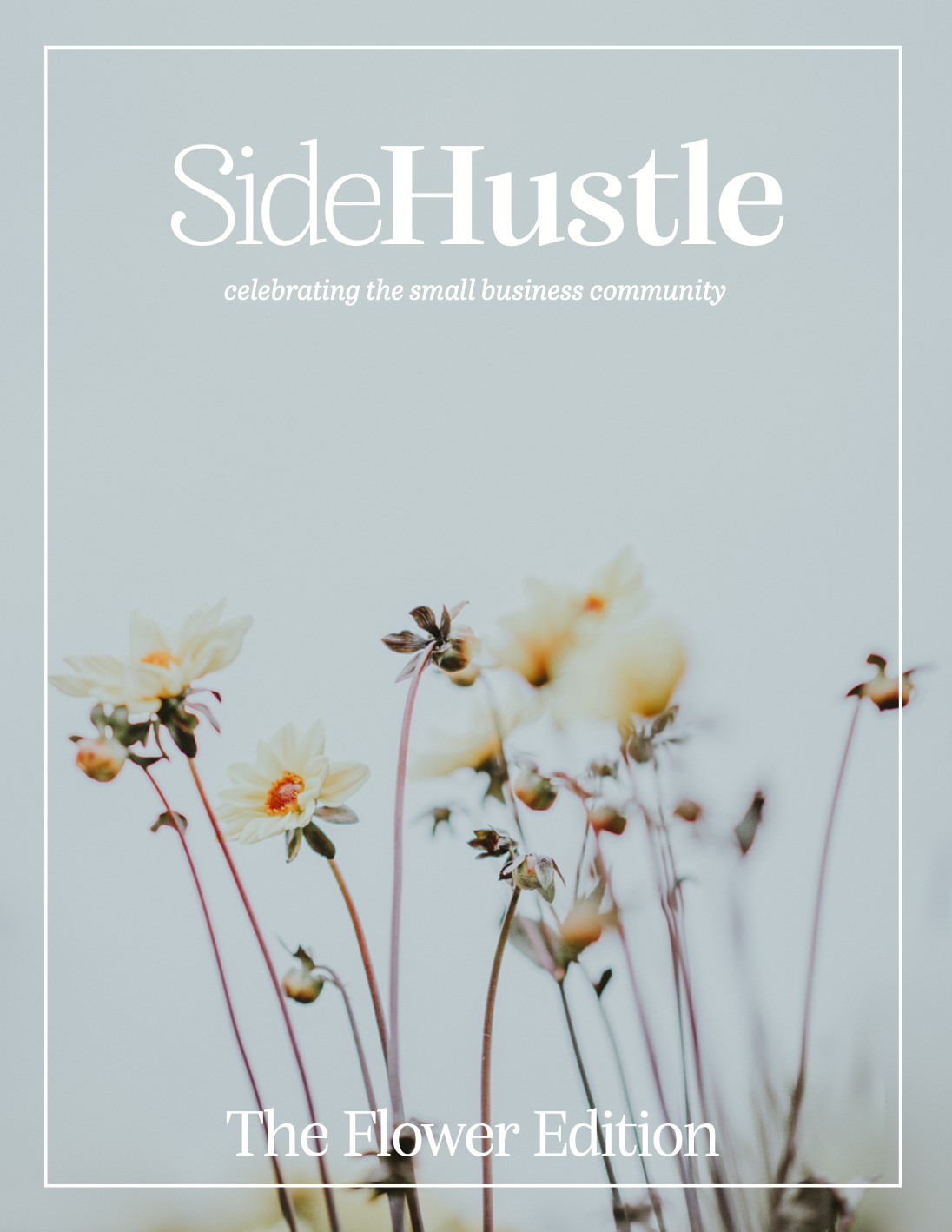
I was the editor for this assignment, which gave me the chance to put my project managing skills to good use. Having started a small business of my own over lockdown, this magazine’s topic is a real passion of mine and it was a great excuse to delve into the community that surrounds online small business, as well as the lifestyle that comes with being a small business owner.
To read a magazine sampler of Side Hustle, click here.
In my second year of university, we studied Social Enterprises and had the opportunity to work with some that are based in the UK.
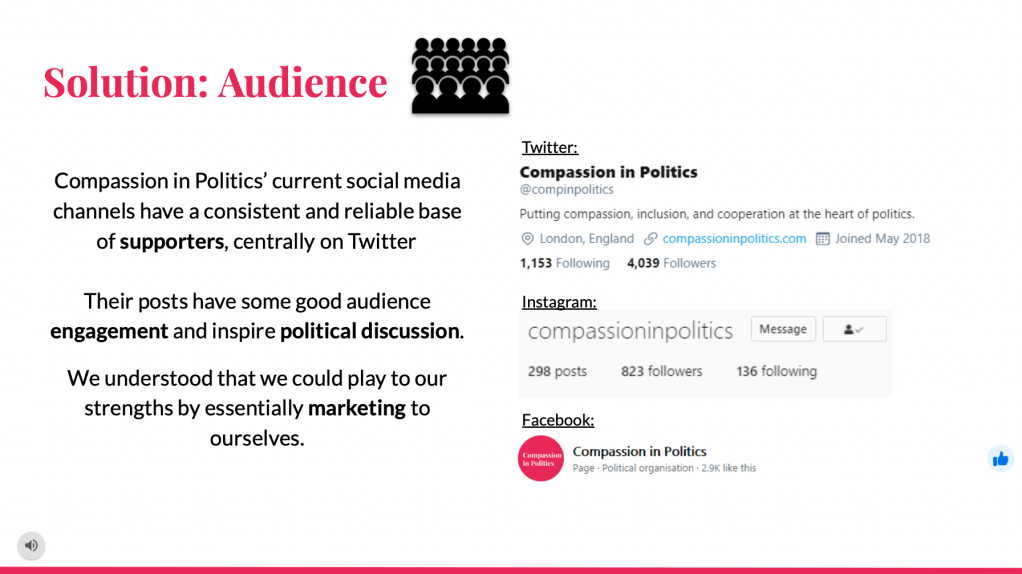
My group worked with Compassion in Politics, a London-based, cross-party social enterprise that works to put compassion, inclusion and cooperation at the heart of politics.
The brief
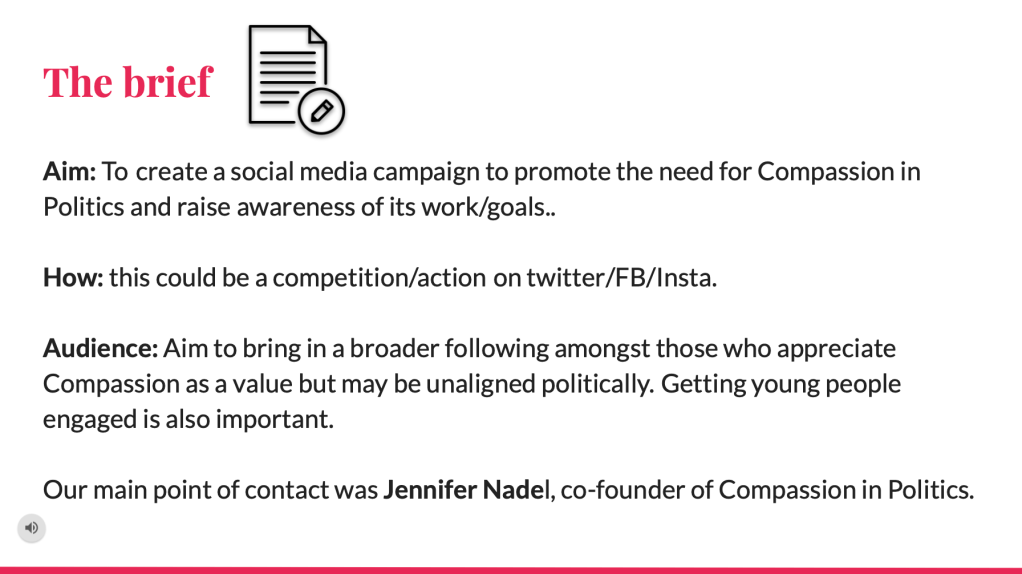
Aim: To create a social media campaign to promote the need for Compassion in Politics and raise awareness of its work/goals..
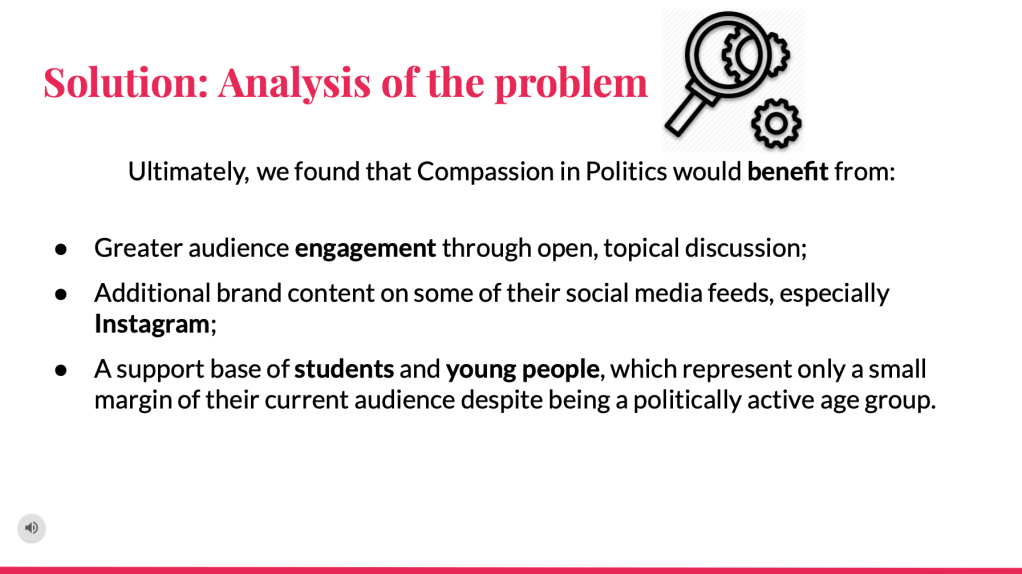
Audience: You are not just speaking to the left of centre audience but aiming to bring in a broader following amongst those who appreciate Compassion as a value but may be unaligned politically. Getting young people engaged is also important. If you’d like to restrict this to a campaign to win the hearts and minds of students that’s fine too.
The project
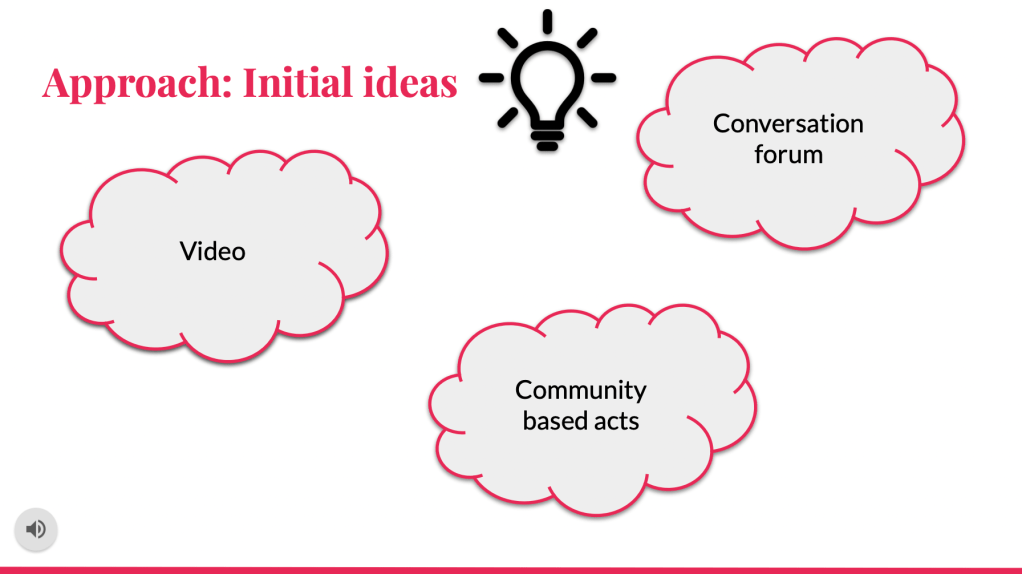
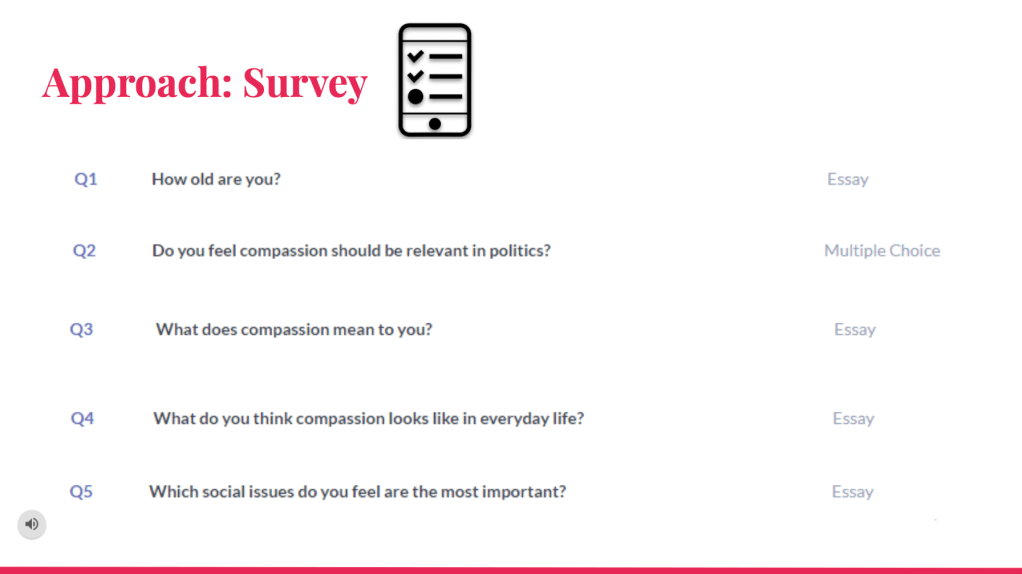
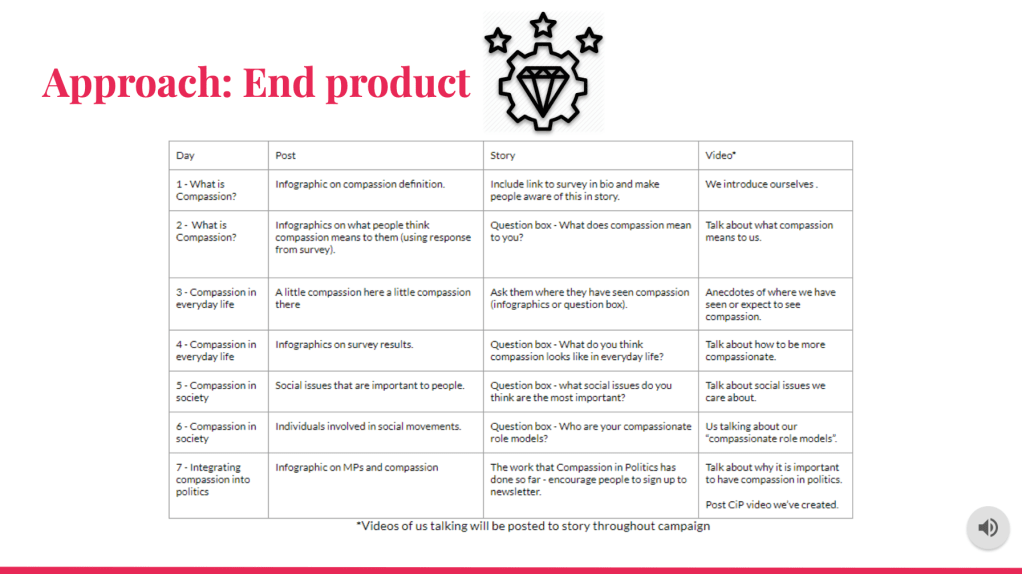
As a group, we carried out a Student Takeover on Compassion in Politics’ Instagram page. We posted on their story, posted engaging posts and created a video for their IGTV.
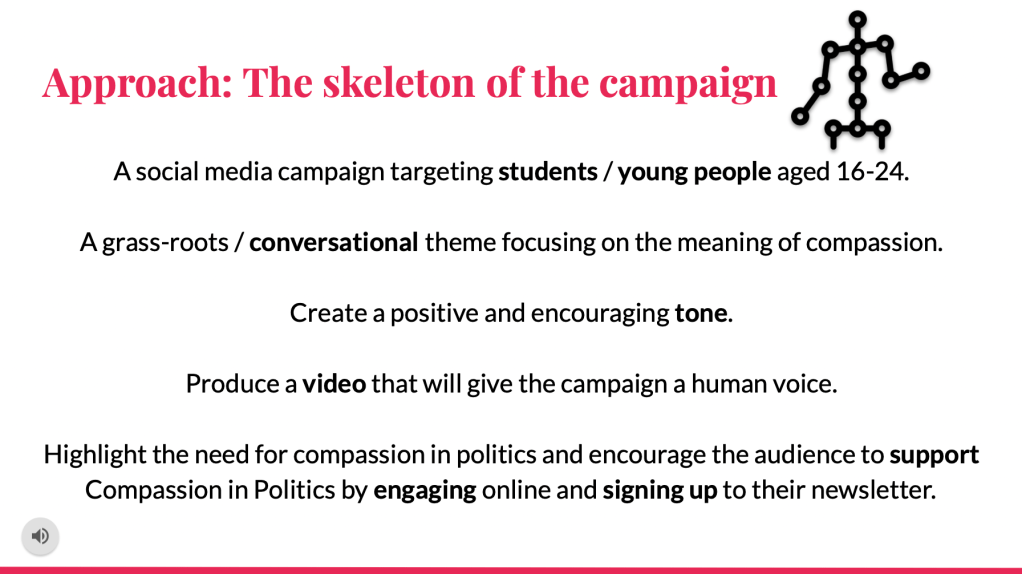
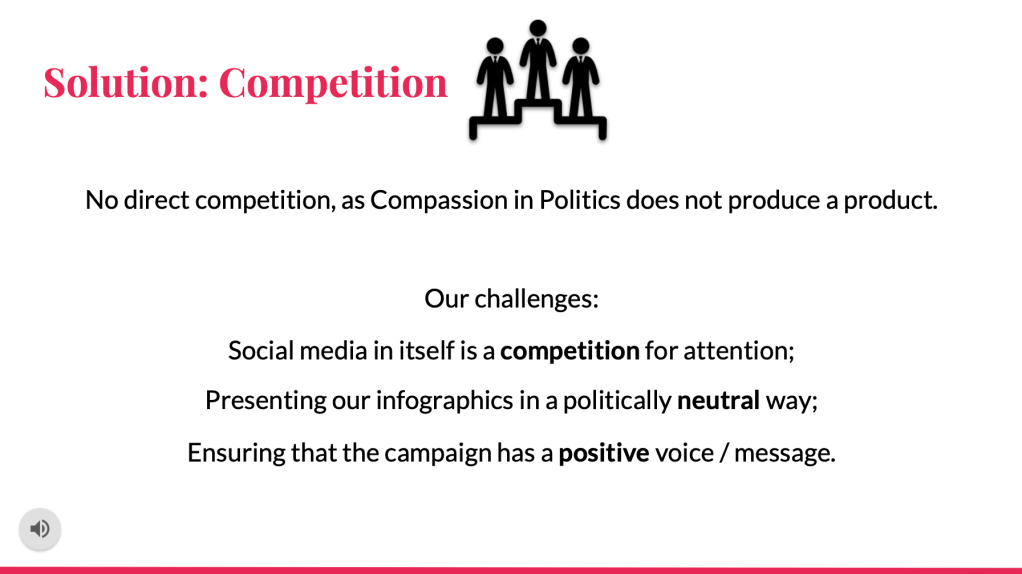
The campaign targeted students / young people aged 16-24. It carried a grass-roots / conversationaltheme that focused on the meaning of compassion and we endeavoured to create a positive and encouraging tone.
The purpose of the campaign was to highlight the need for compassion in politics and encourage the audience to supportCompassion in Politics by engagingonline and signing up to their newsletter.
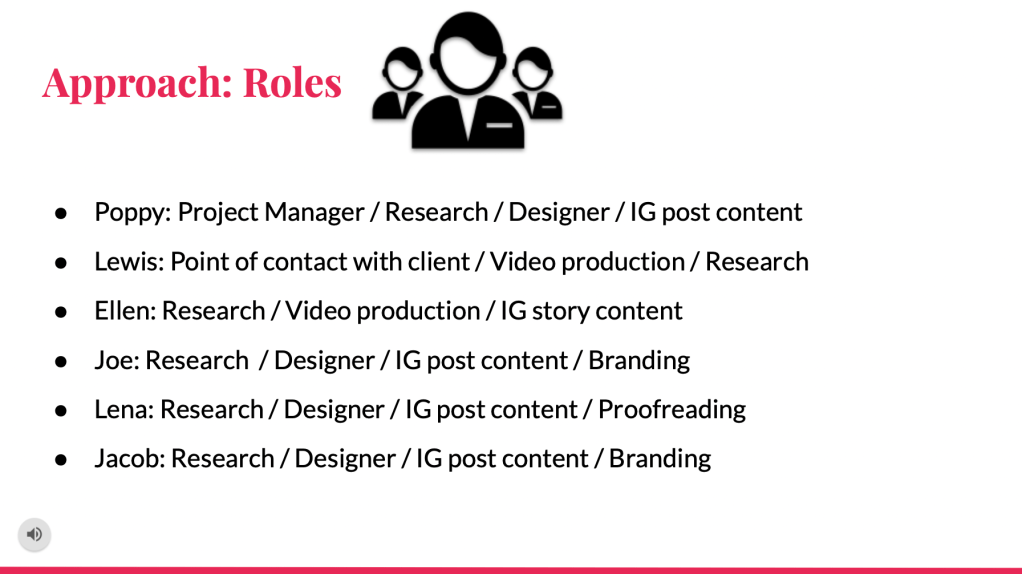
I took the role of Project Manager and created the key concept of the project, whilst overseeing the group’s work.
The Instagram posts
Below you can find the digital assets we created to post onto the organisations’ Instagram. The whole team designed the assets and I ensured there was branding consistency across them all.
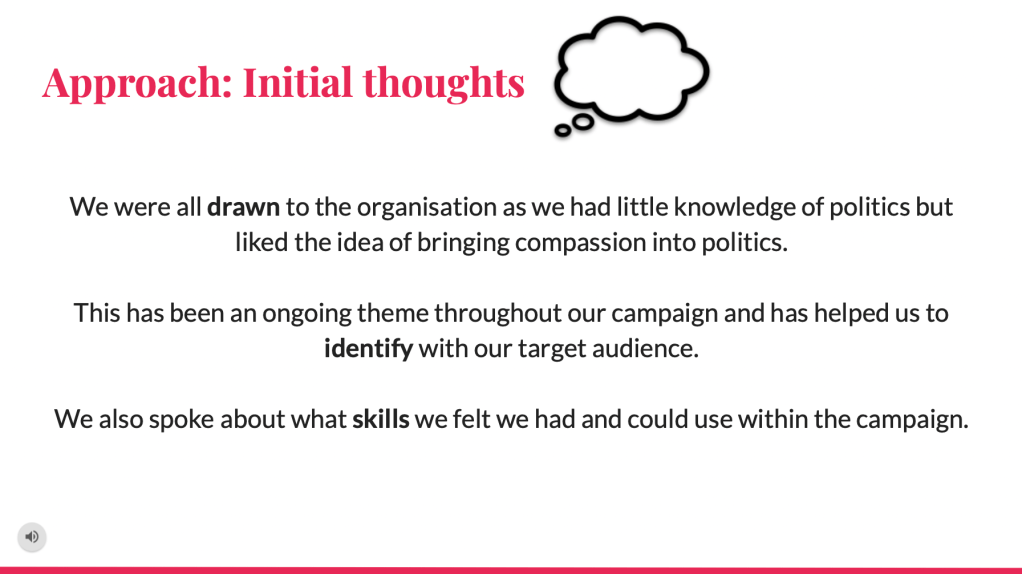
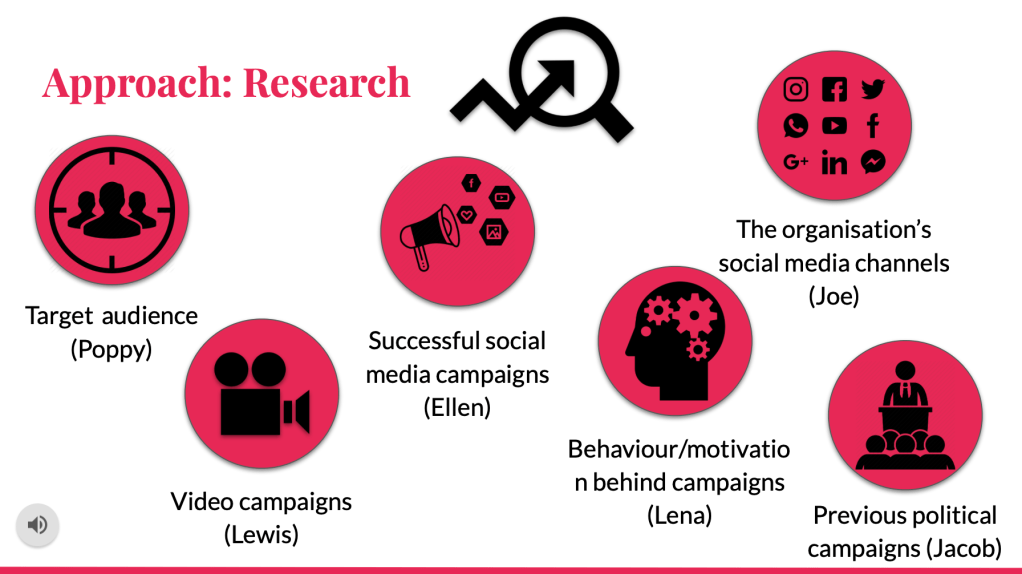
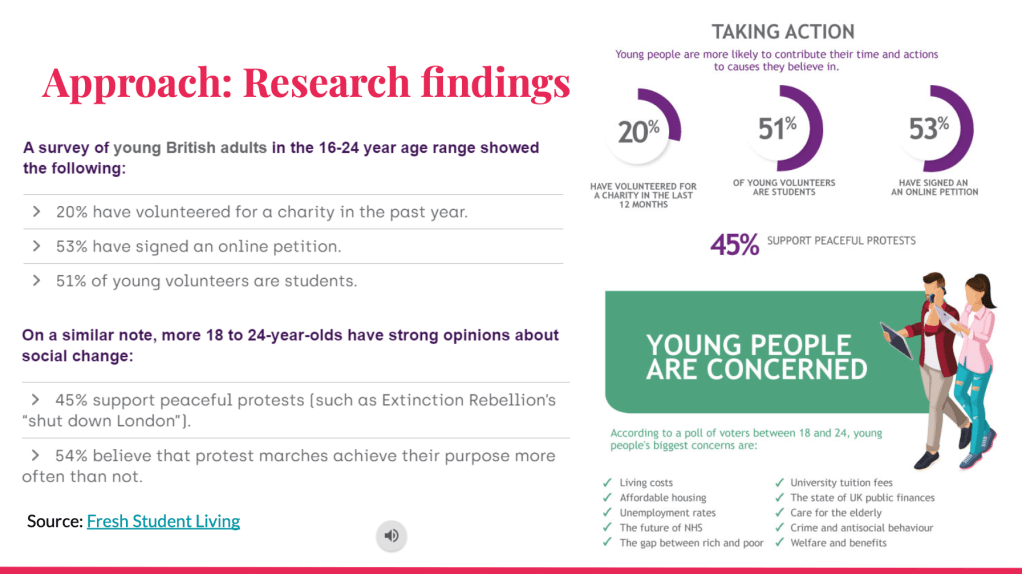
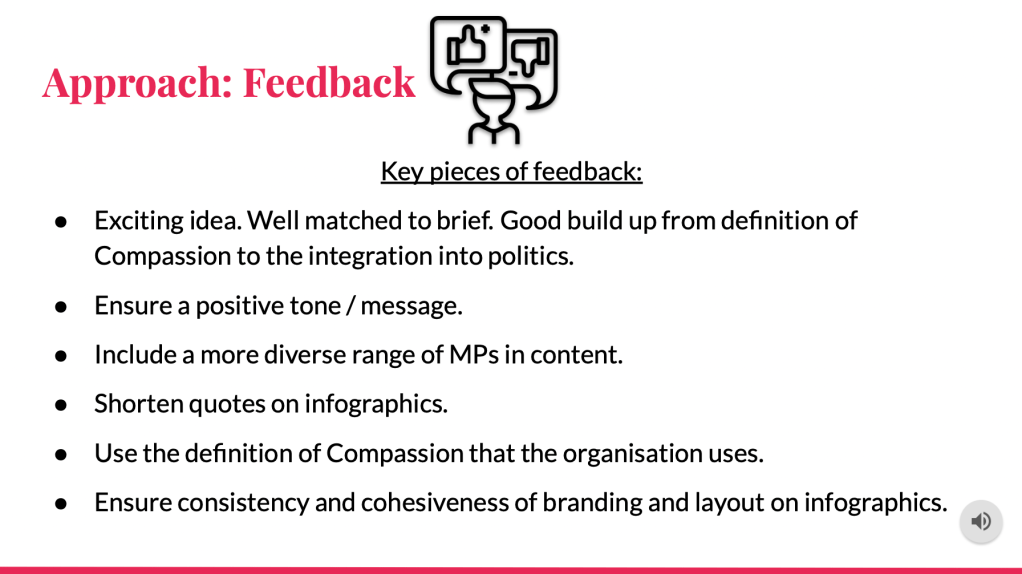
We virtually presented a pitch to our lecturers and the co-founder of Compassion in Politics, Jennifer Nadel. I created the slides for the presentation and wrote the script, which was based on the team’s own research.
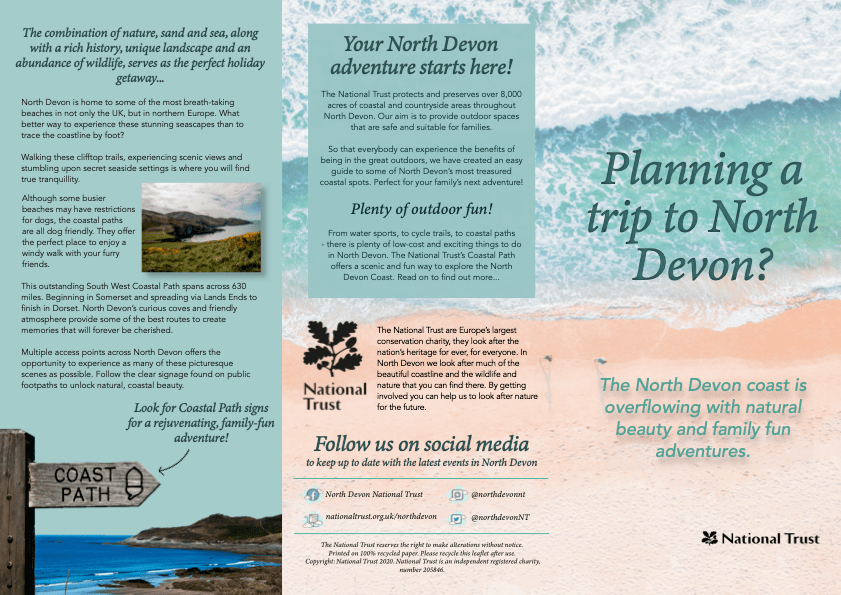
Conceive, write, design and layout your own promotional leaflet. You can choose any subject you like from a charity, cause or pressure group to a band, film or club night.
I grew up in North Devon and spent my childhood exploring beaches and coastal paths. During this project, I enjoyed reminiscing these adventuring times in an engaging and creative way.
For this personal investigation, I have decided to expand my knowledge on how wildlife is protected in Africa. I grew up often going to Africa and climbed the continent’s highest mountain when I was 15 years old, so this topic is something that is close to my heart. My initial thought on this project was to investigate the ivory trade and the effect this has had on today’s population of elephants. I had recently watched a film called Holiday in the Wild and was captivated learning about elephant sanctuaries and the work that they do. However, an interesting conversation with a gentleman from Sudan sparked a change of direction in my approach to this project. He said that the key to change was the education of poachers and civilians in African countries. Many people in these countries are living in poverty and their only source of income often means harming African wildlife. He believes that people need to be taught the importance of these creatures and that keeping them alive would create more money within their communities.
My first source is a book called An African Love Story. The author of this book is Daphne Sheldrick who is part of the David Sheldrick Wildlife Trust, which featured on a 2007 BBC programme, Elephant Diaries. I started this book with the intention to learn about elephants, their behaviours and how orphaned elephants are saved and released back into the wild to conserve their population. However, as well as these insights, the book revealed much more to me. The book takes you through Sheldrick’s life, from her great grandparents migrating from South Africa to Kenya during the colonisation of Africa, to herself being born in Kenya and growing up with regular adventures amongst Kenyan wildlife, to her and David Sheldrick’s amazing work protecting wildlife and fighting poachers. As this source is a narrative, there is a risk of unreliability as stories may be exaggerated to give greater effect. Even so, it has given me a profound understanding of life in Kenya during the 20th Century, the perspective of the people living there and how the poaching and hunting of Africa’s wildlife developed. A passage of the book that sums this up perfectly is when Sheldrick (2013, p.7) is talking of “how lightly my ancestors shot at animals” and explains, “Everywhere there was wildlife … At the time no one ever imagined that any amount of shooting could devastate the stocks of wild game, let alone all but eliminate it”.
The historical context offered in the book sparked an interest into the effect that the development of African countries has had on its wildlife. This led me to watch a range of TED Talks on the conservation of African wildlife. Talks by Lucy King, Jane Goodall and Moreangels Mbizah focused on community-led projects that endeavoured to keep peace between wildlife and surrounding communities. These videos re-iterate my Sudanese friend’s message, about the importance of education and working with people within surrounding communities in order to conserve African wildlife. This source has given me insight into the different projects that have ran or are still in place, for example: Okango Wilderness Project, awareness and education projects in local communities, Elephants and Bees, TACARE and Roots and Shoots. It is hard to tell from the videos how effective these projects are, however, Goodall (2007, 14:33) seems adamant that once projects like TACARE have helped towards “improving the lives of the people living around” animal conservation parks, “they began to understand evermore the need for conservation”. After watching these videos, I researched the speakers and the projects they talked about.
This brings me to my next source, a comprehensive Beehive Fence Construction Manual, developed by Dr Lucy King in accordance with her Elephants and Bees project. The manual gives detailed information on elephants and their relationship with people; the construction and maintenance of beehives and fences; and beekeeping, including pests and parasites to look out for. This source revealed to me a new perspective to this investigation. While we often focus on the idea that poachers are the reason for the decrease in elephant population, King’s manual (2019, p.5) talks of the conflicts between people in local communities and elephants in surrounding areas, it tells us that “unfortunately both people and elephants are sometimes killed due to conflict over resources.” The manual’s main aim is to combat the conflicts between Kenyan farmers and elephants in a natural and humane way that will help to conserve the elephant population. I was drawn to this source as it has such a wide range of information and is set out in a clear and coherent way that is easy to understand and follow.
Tanzania is renowned for its conservation of wildlife. To acquire a greater knowledge of how the country protects its animals, I have spoken to an Expedition and Safari Co-Ordinator and some of the safari guides from a Tanzanian tourism company, Team Kilimanjaro. I was worried that their feedback may be biased, but they gave me lots of useful information and even spoke about challenges the country still faces. Tanzania is made up of many National Parks, and fees paid by tourists to access these places go towards looking after wildlife, including in surrounding areas. Edgar (2020) highlighted the importance of “education on people living near National Parks” – a recurring theme throughout this investigation. New aspects have also been highlighted. Firstly, the Tanzanian government are involved in the protection of the country’s wildlife and Edgar (2020) shared with me that they have put in place “tough punishment to those who disagree” with the rules. Secondly, Edgar (2020) also called to attention the issue that many “people living near animals environment used to do poaching” as a living. National Parks have been instrumental in offering education, projects and, most importantly, employment to students in surrounding communities. Maasa (2020) claimed that offering these people employment minimises the number of poachers and these same workers are also teaching villagers “the benefits of sustainable wildlife”. Screenshots of these Whatsapp conversations can be found at the end of this report.
I have thoroughly enjoyed investigating this issue. The sources I have used have given a variety of different aspects and perspectives of the topic. I feel I started this project with quite a narrow-minded view of African wildlife conservation and only thought of things from a poaching aspect. However, I think I now have a broad view on the topic and have learnt about the many aspects that come into play when discussing the complex conversation of protecting African wildlife.
Bibliography
Anwer. (2020) Conversation with Poppy Evans, 8th March.
Dr Lucy King [TED Talks] (2019) How bees can keep the peace between elephants and humans. December. Available here (Accessed: 25/04/2020).
Edgar, I. (2020) WhatsApp to Poppy Evans, 9th April.
Evans, A. (2020) Telephone conversation with Poppy Evans, 5th April.
Holiday in the Wild (2019) Directed by E. Barbarash. [Feature film]. United States: Netflix.
Jane Godall [TED Talks] (2007) How humans and animals can live together. June. Available here (Accessed: 25/04/2020).
King, Dr L. (2019) Beehive Fence Construction Manual. Nairobi, Kenya: The Elephants and Bees Project. Fourth Edition. Available here (Accessed: 25/04/2020).
Maasa, G. (2020) WhatsApp with Poppy Evans, 9th April.
Moreangels Mbizah [TED Talks] (2019) How community-led conservation can save wildlife. April. Available here (Accessed: 25/04/2020).
Sheldrick, D. (2013) An African Love Story. Great Britain: Penguin.
Steve Boyes [TED Talks] (2018) How we’re saving one of Earth’s last wild places. April. Available here (Accessed: 25/04/2020).
The sun’s gorgeous rays usually come with a busy atmosphere, read my top tips for a summer adventure away from the crowds.
As summer approaches, our pubs, restaurants, and shops are going to be getting busier and busier. Although it’s exciting, sometimes it’s nice to take time away from the everyday bustle and find fun things to do in nature.
A picnic in the park
Parks are a wonderful place to be in the summertime, especially if you live in a city. Here are some top tips for packing yourself a scrumptious lunch that you can enjoy in your local park.
Keep your picnic simple but interesting. If you pack and prepare well enough, it’s super easy to take a lunch that is fully of yummy goodness, as well as light weight and easy to carry. Preparing just a few treats but doing them well is a great way to save space. Homemade sausage rolls and pasties are an ideal goody. If you don’t have the time to make these yourself, you could pick some up from your local deli/bakery!
When preparing your food, plan carefully and strategically. You want to bring enough food to eat, however, taking too much means that you will have to carry it all back, and it is likely that it will be wasted. Be sure to take all your cold food in an icebox/bag. Frozen bottles of water or juice can act as ice packs to keep your food fresh and cold, as well as provide cold, refreshing drinks for the picnic.
Don’t forget to take your favourite picnic blanket with you, and also remember bin bags! If you are enjoying a picnic in your local green space, please, please remember to take your rubbish home with you too!
Go for an adventure
One of my favourite things to do on a sunny summer’s day is to pack up a bag full of munch, lots of water and a warm jumper, and go on a long walk. I love taking fruit with me on these adventure days, as they are easy snacks to have on the go and full of energy and goodness. Take as much water as you are able to carry, as it is so important to stay hydrated when you are out for long walks, especially on super-hot, sunny days!
Everybody has their preferred ways of going for walks, I personally love walking along public footpaths in whichever direction and getting a little bit lost. Of course, it is important that you don’t actually get lost! However, the joys of Google Maps means that you can put in your home address wherever you are and get directions all the way home. But make sure you have enough charge on your phone when setting out for your walk! If Google Maps does not pick up your location, walk to the nearest road and then it should pick you up (but most public footpaths are shown on Google Maps).
If you’d prefer to, you could also plan a walking route to take beforehand. This means that you could find a nice village pub to stop off at for lunch, it’s always nice to find new places to eat!
Some footpaths take you through fields with animals in it. If this is the case, please remember that you are entering into their territory. Be respectful and mindful to the animals, walk around the outside of their field and don’t be disruptive or make too much noise. Believe me, you do not want to be chased by a herd of cows!
Take a trip to the beach
For some of us that live near the coast, taking a trip to the beach is an easy and simple day out. For others, a beach trip also involves a small road trip too. Whether you live near the sea or not, a day out at the beach is highly recommended!
Not only is a beach trip super fun, it is actually beneficial for your mental wellbeing! According to research, being near the ocean is a relaxant. The sounds of the sea and waves can alter your brain patterns, lulling you into a relaxed state and rejuvenating your mind and body. Be sure to bring your favourite book with you on your trip and see if you manage to get a few moments of quiet, relaxed reading.
As well as the relaxing elements, a trip to the beach can encourage physical exercise. Water sports, such as swimming, surfing and bodyboarding, are a great way to get your body and muscles moving. They have amazing benefits for loosening any tight muscles in your upper back and shoulders.
For those of you that aren’t so keen on getting in the water, there are plenty of games to play on the beach too, especially if you’re in a big group of people! When packing for the beach, why not think about taking a football, rounders/cricket set, or even just a frisbee?
How ever you choose to spend your sunny days this summer, there are a few things to remember:
Stay hydrated – Drink lots of water, especially in hot weather.
Remember your sunscreen – Skin care is crucial!
Take your rubbish home – If we are going to spend time in nature, we must show it respect.
Think wildlife – Be mindful of the inhabitants that live in the areas you’re visiting.
Warm clothes – I find it helpful to always bring a warm jumper when spending a day outside. After all, this is an English summer, so it gets cold quite quickly!
Image credit: Aleksandra Boguslawska via Unsplash.
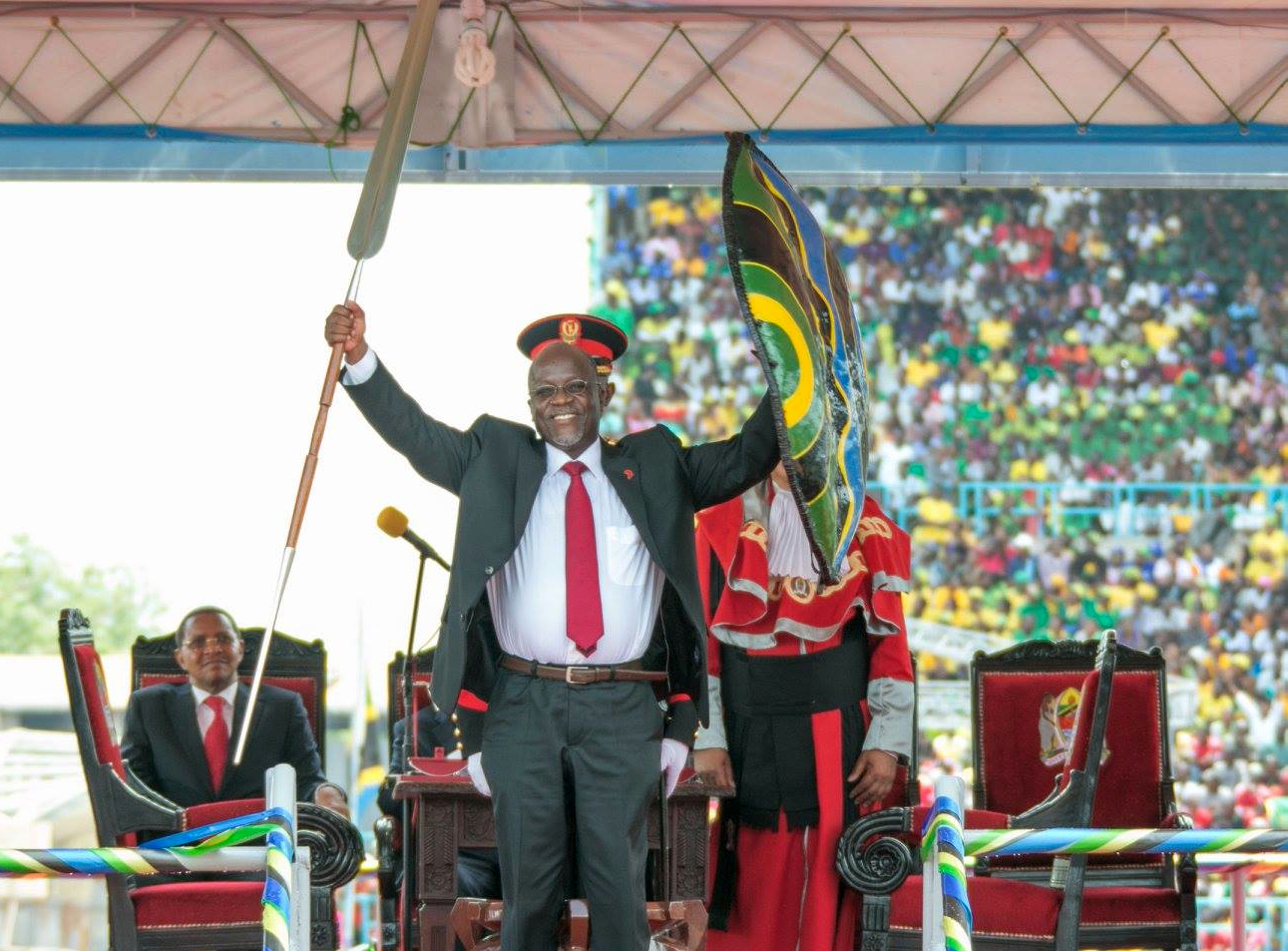
“Mr President Magufuli was my man with a good heart to his people,” says local mountain guide, Faraja Mwaijande, of the late President of Tanzania, who died of heart complications on 17th March 2021.
Dr John Magufuli was a divisive figure within the governmental ranks, one citizen described him as “the president Tanzanians needed”. However, throughout his presidency he was heavily criticised and known by many as “The Bulldozer”.
But why the controversy? What was it about this man and his presidency that divided opinion throughout not only Tanzania, but the rest of the world too?
Tanzania under President Magufuli
“The Bulldozer”
When asked how Magufuli’s presidency impacted Tanzania, a local tour guide reported:
“The best of all is that he installed integrity in the entire society, from governmental heights to individual level with us as citizens.”
From the start of his presidency, anti-corruption was an important issue to Magufuli. As reported by Africa News in 2016, he “vowed to root out corruption in his ruling party, threatening ‘no mercy’ for anyone giving or taking bribes”.
Within days of becoming president, he was making big changes, such as cancelling Tanzania’s independence day fete and instead putting this money towards much-needed roadworks. He also fired many government officials in what the BBC described as his “anti-corruption crusade”.
It was his hard-headed approach that bestowed him the nickname, “The Bulldozer”. However, Tanzanians, and people throughout Eastern Africa, found admiration in his methods.
A man that loved his nation
Magufuli’s view on the relationship between the government and its citizens impacted many Tanzanians. Mwaijande claims that thanks to Magufuli:
“People know it is the responsibility of government office to help and solve problem on behalf of Tanzanian citizens… He was the best president of Tanzania after our first President Nyerere, in my opinion.”
Coming from a humble background, Magufuli wanted to help the poverty levels of Tanzania. James Nasary, a local guide, shared:
“President Magufuli grew up a labourer. In his lifetime he wanted to remove the strata of his people between the ‘haves’ and the ‘have nots’.”
Magufuli endeavoured to do this by enhancing the use of resources within the country and encouraging hard-work and dedication.
Mwaijande explains:
“You know, we have so many natural resources, but most local people didn’t know how we could benefit from them. Mr President Magufuli opened Tanzanian eyes to know we can get our shares from all big companies’ investment.”
Another citizen described:
“His motto was ‘hapa kazi tuu’, meaning working is the only valid thing. This boosted the nation’s spirit of labour to a level that Tanzania was last year announced by World Bank it has entered intermediate economy.”
Who was Magufuli? (1959-2021)
On 29th October 1959, John ‘Walwa’ Joseph Magufuli was born in Chato, North-West Tanzania.
The Citizen calls him “a peasant’s son”, and explains how, “author Mathias Kabadi describes John Magufuli’s family as: ‘a very common family of farmers and pastoralists’.”.
He worked his way from primary education at Chato School in 1967, to graduating in Maths and Chemistry from the University of Dar es Salaam in 1974.
In 1982, he achieved a Diploma in Education of Science, specialising in Chemistry and Maths. This led to his first job, teaching Maths and Chemistry at Sengerema Secondary School.
This was a short lived employment, as in 1983, due to compulsory laws in Tanzania, he joined the National Service (JKT). The Citizen reports that according to JKT training, “Magufuli was a dedicated and hardworking man”.
After his service, Magufuli returned to education in 1985 until 1988, gaining a Bachelor of Science in Education, majoring again in Chemistry and Math.
Following a short time working as a chemist in a Nyanza Cooperative Union factory, Magufuli went to the University of Salford (UK) from 1991 – 1994 and obtained a Master’s degree in Science. He later achieved a PhD in Chemistry at the University of Dar es Salaam in 2009.
It was whilst gaining his PhD that Magufuli began to pursue governmental responsibilities.
He was first elected MP for Chato in 1995 and appointed Deputy Minister for Works by then-President, Benjamin Mkapa. He was re-elected MP for Chato in 2000; made Minister of Lands, Housing and Human Settlements from 2005 – 2008; and appointed Minister of Livestock Development and Fisheries in 2008 – 2010.
Magufuli was elected President of the United Republic of Tanzania in 2015 and re-elected for his second term in October 2020. He served up until his death on 17th March 2021.
This statement is supported by the World Bank, declaring:
“Following two decades of sustained growth, Tanzania reached an important milestone in July 2020, when it formally graduated from low-income country to lower-middle-income country status.”
Magufuli also focused on trying to optimise structures within Tanzania. Nasary, explains:
“[He] build country infrastructures, healthy centres and he was trying to unite East Africa countries in business alliance and development to each other… He trusted that citizens could build their own country… He build the capital city in proper way in terms of roads, electricity railway and tried to build Dar es Salaam as business city. Also, Magufuli build international airport in Chato in order to widen tourism sector in Northern parts.”
So, why the controversy?
Amongst the good intentions he had for Tanzania, he has been heavily criticised and often described as a dictator. This has been brought about by a range of policies and bans that he put in place:
Media restrictions
One of the greatest criticisms of Magufuli is his censorship of media. The BBC reported that Magufuli “muzzled Tanzanian media, shutting down several newspapers, radio and TV stations as well as social media platforms simply for reporting what the government didn’t like.”
In November 2015, Magufuli limited foreign travel to emergencies only for all public officials. By 2019, this policy was relaxed, but they could only travel with a permit.
This strategy was in place to reduce government spending, and the BBC reported that:
“A central bank report in early 2017 revealed that the government had saved $430m (£330m) by limiting foreign travel between November 2015 to November 2016.”
Pregnant schoolgirls
In Tanzania, schoolgirls are expelled if they fall pregnant. Although Magufuli has been widely criticised on this issue, it was in place for four decades before his presidency.
However, when there was opportunity to nullify the policy, Magufuli did not go through with it. This caused division within his government.
Political rallies
From the start of his presidency, Magufuli was clear that he did not want political leaders initiating rallies. The BBC reported:
“He argued that people should be left alone to focus on ‘building the country’, and political leaders should wait for the next election in 2020 to hold rallies.”
This did cause concern amongst some citizens, as one shared, “…he also almost killed democracy in Tanzania”.
COVID-19
Magufuli’s stance on the pandemic has caused great conversation and concern throughout the whole world. He believed in taking a natural approach to the virus and did not lock down the country. On 21st February 2021, Reuters reported:
“President John Magufuli’s sceptical approach towards COVID-19 has caused alarm among WHO officials.”
Although there are clear concerns in the way that Magufuli tackled issues within Tanzania, there has still been praise from its locals. A Tanzanian, stated:
“He believed in Tanzania’s wealth; something that made him an enemy with most western countries calling him a dictator. Even if he was one, to me he was a leader I really wanted to help end Tanzania ignorance with many.”
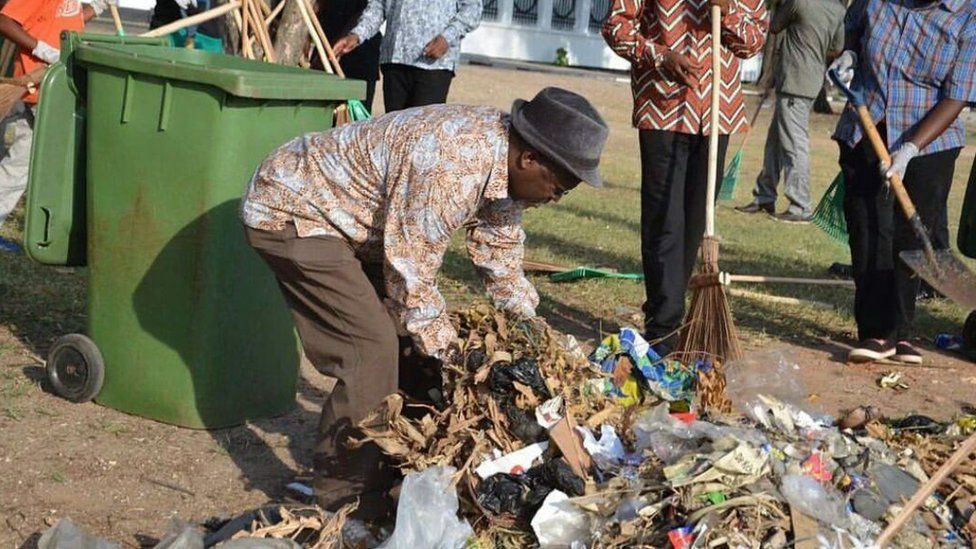
President Magufuli helping clean the streets of Tanzania: In late 2015 and early 2016, #WhatWouldMagufuliDo became a trend on Twitter. Credit: BBC.
A new presidency
Since Magufuli’s death, his vice-president, Samia Suluhu Hassan, has taken office. These are new and exciting times for Tanzania as she is the country’s first female president.
Mwaijande has shared his thoughts regarding this:
“I am very positive about my president Samia Suluhu Hassan. She was working with President Magufuli so they had same goals… She is true leader we have to give her time to show how much respect and love she has for our country… For me, I expecting a lot from my President Samia Suluhu Hassan… I pray for her to have power to do the best for our country.”
Although there is an air of positivity surrounding this new appointment, there are concerns surrounding the return of corruption. One local shared:
“I think Magufuli’s death may impact Tanzania integrity, a thing which may bring back corruption… from only a day after his death we experience big scandals of corruption, which forced Madam President Samia to re-appoint a new cabinet of ministers to assist her reign.”
A citizen observed that an appointment of a female president may have been Magufuli’s plan all along:
“Magufuli knew of his health status and he was always ready to departure, though wishing to leave a legacy… It’s like he knew for Tanzania to have a female president it will be a dream with current generation.”
Having already made a difference in media freedom and foreign policy, it will be exciting to see what further work the new President Hassan has in store for Tanzania.
I wrote this article in May 2021 for an International Journalism module. We were tasked with writing a 1,500 word topical feature article on a country of our choice.
It is suggested that we aim to drink 6-8 glasses of water a day, this amounts to around 1.2 to 1.5 litres. So why is it so important that we drink water and how does it affect our wellbeing?
I can be the first one to admit that I definitely don’t drink enough water. I try to bring it into my daily routine, but it’s very easy to forget. This is why I think it is important to remind ourselves of the benefits of drinking water and how it can impact our overall wellbeing.
Brain functioning and energy levels
Drinking water keeps you hydrated, so when you’re not drinking enough of it, it can negatively impact your productivity and general mood. Studies have shown that fluid loss (which can occur during everyday activities) impacts:
Mood
Concentration
Memory
Frequency of headaches
Anxiety and tiredness levels
I can tell that I’ve not been drinking enough water when I have difficulties concentrating on work. Similarly, whenever I feel a headache coming on, I immediately go and drink a pint of water.
A headache is one of the most common symptoms of dehydration and for some, this frequently results in migraines. Studies have even suggested that drinking water can reduce headache frequency in people that suffer with them.
Water and your mental health
Research has shown that there is a connection between drinking enough water and having good mental health. Being dehydrated may well increase your risk of depression and anxiety.
According to Healthline, a study in 2018 showed that drinking more water lowered the risk of anxiety and depression. The connection between dehydration and depression was stronger, but results showed that anxiety levels were higher in those that weren’t drinking enough water.
When I struggled with anxiety and panic attacks a few years back, I took a look at what I was putting into my body. When buying a snack, the first thing I would go for was a chocolate bar and a Lucozade sport, or a fizzy drink. I made a conscious decision to change this and started buying water and fruit instead. I think that this was one of the most important steps I took in fixing my mental health.
Looking after your skin
Skin is the largest organ in your body, it only makes sense to keep it hydrated. Drinking enough water is a natural way to get the glowing and healthy skin that we’re all looking for.
If you are someone that suffers with spots or acne, then it is super important that you’re drinking enough water! Spots are caused by toxins clogging up your pores. Drinking more water keeps your skin hydrated and therefore minimises clogging.
Furthermore, keeping your skin hydrated helps to maintain its elasticity. Drinking large amounts of water decreases scars, wrinkles, and soft lines, meaning that signs of aging are lessened. As you get older, it will be more difficult for your body to retain water, making it crucial to ensure you are drinking enough of it now.
I like to picture my skin as a piece of fruit – once they are dehydrated, they become coarse and wrinkly. Who wants to be a shrivelled-up raisin? Not me!
Weight loss
There are so many reasons why drinking water aids weight loss! I think this section is in need of some bullet points:
It is a natural appetite suppressant – often we think we are hungry, when really it is likely that we need some water. Similarly, water takes up space in our stomach, leading to reducing hunger and leaves you feeling full.
Water increases calorie burning – this can be during exercise or resting. Drinking cold water further enhances this as the body uses up energy/calories by heating up the water to digest it.
Aids digestion and helps to remove waste from the body – drinking water helps to filter your kidneys and minimises constipation, keeping everything down there flowing smoothly.
Reduces calorie intake – as water has no calories, drinking just water rather than all the other drinks out there means that you are minimising your overall calorie intake.
You need water to burn fat – without drinking water, your body is unable to break down fats and carbohydrates. In fact, drinking plenty of water increases your metabolism.
Working out – it is imperative that we drink water before, during and after our workouts. It helps the lungs, heart and other organs to function, and also helps muscles, joints and connective tissues to move correctly.
Drinking water when you’re ill
It is crucial that you are drinking enough water when you’re sick. First of all, sweating, fevers and running noses all increase body fluid loss, which may well lead to dehydration. Furthermore, drinking plenty of water relieves congestion and loosens the mucus in your nose, pushing you towards a speedy recovery. Similarly, staying hydrated helps the body’s overall functioning and means that it is better equipped to defends itself against illness.
There are many more benefits of drinking water, but these are the ones that I feel are most influential on our overall health and wellbeing. I do hope that this has spurred you to want to drink more water, because it is honestly so important for us! Now don’t mind me, I’m off to grab a glass of water!
In light of the sad news of Sarah Everard’s death, important conversations were taking place over the course of March. Here is a step-by-step guide to understanding the criteria of complimenting.
The Guardian have reported that four-fifths of women in the UK have been sexually harassed. The sheer numbers and stories surrounding the sexual harassment conversation have led me to wonder – should we be discussing the difference between a compliment and a catcall?
Now, let’s explore two scenarios:
Scenario 1: A woman is walking down the street. A car drives past slowly with two men in the front, staring at the woman. The woman automatically feels watched and slightly vulnerable. They wolf whistle out the window, or shout something like, “Oi oi sexy!” before driving off, laughing. The woman feels embarrassed and self-conscious.
Scenario 2: A woman is walking down the street. A man walks past, the two of them catch eye contact and smile at one another. The man says to the woman, “I don’t mean to be rude, but you have a wonderful smile.” The woman says thank you and the two carry on walking in their opposite directions. It is likely that the words of a stranger made that woman’s day.
What are the differences between these two scenarios? Can you spot which is a compliment and which is a catcall?
The Cambridge Dictionary defines ‘compliment’ as: “an action that expresses approval or respect”. Whereas Merriam-Webster defines ‘catcall’ as: “a loud, sexually suggestive call or comment directed at someone publicly”.
What is your aim?
The first question to ask yourself in a complimenting environment is, “What are my motives in saying this?”. A compliment should not be a means to an end. Are you giving the compliment to make the other person feel good? Or are you making a remark because you would like something back from that person. Catcalls are about the person giving them, whereas compliments are about the person receiving them.
Permission
Reading social cues is key. Looking at the afore mentioned scenarios, a major difference is that in the latter, the two caught eye contact. Not everybody wants to be complimented. If you are walking past someone that is looking down and avoiding eye contact, it is highly likely that this person does not want to be disturbed. However, if the person’s body language is open and approachable, and you are respectful in your manner, it is more likely that your compliment is taken as one.
Watch your words
Are you being respectful in your compliments? Would you feel comfortable if your words were said to somebody that you are close to? If you spoke to your female friends in the same way, would you be coming off as a creep? Compliments come from respect, but catcalls come from a place of power.
It is not only how you say it, but it is also what you say. If you are commenting on somebody’s smile or style, you are showing that you see them as a human being. Making remarks that are too friendly or of a sexual nature, are dehumanising and often makes a woman feel objectified.
Being polite
Would you feel comfortable being stopped by a stranger on the street? Before giving any sort of opinion or remark, basic social etiquette is crucial. Starting an interaction off with respect and courtesy with something such as, “I’m sorry to bother you”, can make a big difference on how somebody receives your compliment. Greeting a stranger with something such as, “Hey there gorgeous”, can instantly put a woman on edge. The intentions may be good, but what makes you think all women want to be called gorgeous by a complete stranger?
To include your motives (or lack of) also goes far. As mentioned above, compliments are not given to get something from that person. Making it clear that you are not ‘trying it on’ or want anything from her, validates to the woman that she is receiving a compliment.
A positive reaction?
A significant difference between a compliment and a catcall is the way that it is received. Once you have given your compliment, read their reaction. Do they look happy by what you have said? Did they respond with a smile and a thank you? Has is sparked a positive reaction? If so, you can carry on with your day, knowing that your compliment has made somebody happy.
But if they look shy, awkward, and uncomfortable, it is likely that your remark was not taken as you intended. The best thing to do in this situation is to apologise and keep walking. If they don’t want to be spoken to, even with good intentions, do not hang about.
If you’re not sure, don’t do it.
Remember, a compliment is about the person receiving it. If you have any other motive for making remarks towards a woman, then it is no longer a compliment. Catcalling puts women on edge and makes us feel unsafe and vulnerable. Sometimes this is not the intention, which is why it is so important that we start to recognise the fundamental differences between the two.
Renowned in the Western world as Tanzania’s “COVID-denying” president, John Magufuli’s response to the global pandemic has been a surprise to many.
Tanzania last updated the World Health Organisation with COVID cases and death statistics on 8th May 2020. Reuters has reported, “President John Magufuli’s sceptical approach towards COVID-19 has caused alarm among WHO officials”.
Tanzania’s response to COVID
Magufuli’s initial response to the pandemic had been one of emergency. However, after a pawpaw fruit and goat tested positive for COVID, the president declared doubts on the accuracy of tests imported from abroad.
Although reports describe Magufuli as COVID-denying, this does not seem to be the case. Safety measures, such as hand sanitisation, mask-wearing and social distancing, are in place in Tanzania.
However, the president has not put the country into lockdown and measures are not mandatory, just recommended.
Many Tanzanians have supported Magufuli in his response to COVID. Local mountain guide, Faraja Mwaijande, 45, shared:
“President Magufuli didn’t lockdown the country because most of Tanzania are working to get our daily bread, as we don’t have sustainable income, which was a good move.
“From my point of view, our government did a great job… here in Tanzania, we follow COVID guidelines, but we are not fearing, which makes us feel free and keep working and living normal life.”
John Leonard Minja, 34, has also commented, “COVID exists, and precautions must be taken while fighting to earn our daily bread, for if we don’t keep on with life, death shall be there via hunger and other life-threatening agents.”
Has this been detrimental for Tanzania?
Reuters reported, “The United States said that Tanzania… is experiencing a surge in COVID-19 cases and its healthcare facilities could be quickly overwhelmed”.
When asked to comment on this subject, Mwaijande said that hospitals “[…] are not overwhelmed, just normal. We are not in a bad condition like Western media says.”
He also shared, “Many people get symptoms of Corona and get cured, but very few have died from COVID.”
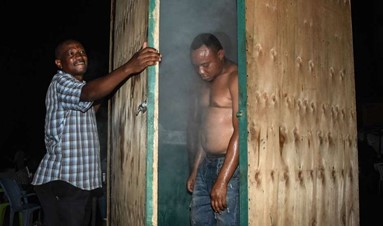
There is no cure to COVID, however, Magufuli has been an advocate of combatting it using traditional treatments; specifically steam inhalation, known as ‘kufukiza’ in Swahili.
When asked if people in Tanzania are still contracting COVID, James Nasary, 26, responded:
“Of course, especially those who live in high population… now people know how to live with the disease, by using local medicine… these remedies combine different trees.”
However, he went on to add, “But in my personal opinion, I do not recommend these because research has not been done by health professionals.”
Traditional medicine has been a part of Tanzanian culture for centuries. Different natural treatments are used depending on the traditions of a tribe.
Mwaijande, a Nyakyusa tribesman, explained:
“People in villages have traditional healers, they know plants and roots that you can use to treat most illnesses.
“If you get cold or other flu illnesses, they will use a steam incubator by boiling eucalyptus leaves and other plants. We have quinine tree that you cut bark off, boil it and drink it, which is treatment for Malaria.”
But not everybody is convinced. In his blog, Shauji Saidi Mpota, states:
“Despite the government reporting that there have been no cases of the coronavirus in Lindi region… myself and a significant majority are of the view that it still exists in our region, but at a small rate compared to the early months.”
As there is no data available on Tanzania’s COVID statistics, it is difficult to determine how successful the country has been in combatting the virus. Nevertheless, Tanzania has a strong, cultural heritage that it is now relying on in these difficult times.
Tanzanian hospitals, Muhimbili National Hospital (MNH) and Mloganzila, have installed steam inhalation machines to help combat COVID. PHOTO via Daily Monitor
I wrote this article in April 2021 for an International Journalism module. We were tasked with writing a 600 word piece on a country and topic of our choice.
We all know the toll that this pandemic is having on children and their mental health. Let’s make this Easter their best one yet and fill the day with fun activities to make them feel super special during these trying times.
Easter egg hunt
What is Easter without an egg hunt? Some of my fondest Easter memories consist of racing my brother to an egg that we both spotted from across the room. Whether you choose to carry the hunt out in your garden or within your house, there is no doubt it’ll bring excitement, tastiness and laughter to your household this Easter Sunday.
Bake an Easter treat
There are so many yummy Easter treats that you and your little one could make this Easter – just about anything chocolatey would suffice! If you want to make something less chocolatey, bunny-shaped cookies would be ideal, or your favourite type of fairy cakes topped with buttercream icing and mini eggs would go down a treat!
Here is a simple, yet delicious, Easter favourite that’s quick, easy and perfect for making with young children.
Easter nest crispy cakes:
Ingredients:
150g dark chocolate (broken into little pieces)
50g butter
2 Tbsp honey
100g Rice Krispie cereal
36 Mini-Eggs
Method:
Line a muffin tin with 12 cupcake cases.
Melt together the chocolate, butter and honey.
Add the Rice Krispies and stir well.
Spoon the mixture into the 12 cupcake cases. Gently press down with the back of a spoon to make small hollows and give a nest-like shape.
Pop three Mini-Eggs into each hollow.
Put the cakes into the fridge for around an hour (or until the cakes have set).
Enjoy a yummy Easter treat with your little one!
Decorate eggs
There are a couple of ways to go about getting creative with your egg decorating this Easter.
The first way is to keep it plain and simple: draw egg shapes on plain paper and cut these out, ready for your little one to draw, paint, glue, whatever it is you choose!
The second way is a little more complex, but much more rewarding. Plus, it’s nice to do something a little different on such a special holiday. This method includes hollowing out an egg – don’t worry, you are still able to use its contents (perhaps make some scrumptious scrambled egg for an Easter breakfast?).
To hollow the egg, take a needle and make a hole in one end of it. Be sure to push the needle all the way in and break the yolk. It is best to do this over a bowl to avoid excess mess.
Next, make a smaller hole on the other side of the egg. Blow through this hole and the contents of the egg should come out into the bowl below. Wash the empty egg under the tap and leave to dry before decorating.
When it comes to decorating, be as creative and messy as you choose! When I was younger, I loved decorating my eggs with paint, sequins, pom-poms, googly eyes, the whole lot!
Why do we celebrate Easter?
It is important to remind ourselves (and our kids) about why we celebrate Easter. Whether or not they are stories that you believe in, we should be aware of the origins of the holidays that we celebrate within our culture. Plus, what child doesn’t love storytime, right?
The CBeebies offers a whole page of information around celebrating Easter and where the tradition stems from. This page can be found here.
To encourage reading and engagement with books, why not buy a children’s book on the Easter story that you and your little one can read together on Easter?
A perfect finish to this storytime could be to find an Easter song that you and your child could sing to together. Who doesn’t love a good old dance and sing along?






 GRACEFULL REFLECTIONS