I think it’s safe to say that the word “conventional” was never used to describe Mum. She viewed life through a lens just a little bit different to everyone else’s and it was often very beautiful. But I think the area where her unconventionality was most evident was when addressing health.
When I was about 8 years old, I clearly remember Mum claiming that if she ever had cancer then she would refuse conventional treatment (like chemo), fly to Mexico and go to an alternative medicine centre there. Little did I know just how accurate this statement was.
Making big decisions
When Mum was diagnosed with cancer, she spoke to the doctors about the different treatment options, but I knew exactly which medical path she would take. As you would expect, she received a lot of push back from medical professionals and friends, it’s not often people decide to take on cancer in the way that she did.
I remember saying to her that whatever decision she makes, I’ll support her. I also felt the need to point out that if she did change her mind and wanted to go down the conventional route, then that’s ok too.
But essentially, doctors told Mum that she would likely die in around three months without any medical intervention. They said that with their treatment, there was a 65% chance she would live for a few more years. Understandably, those figures were not enough to convince Mum.
We were also very aware that the information given by doctors was not definite. No human can be sure. But we have a God that knows the exact number of minutes we have left on this earth, and Mum chose to trust Him instead.
The alternative route
So it was decided. Mum was going to fight her cancer naturally. She had been watching a video series called “The Truth about Cancer”, which looked at cancer through a range of lenses, such as emotional, dietary, biological. This is something that really helped her. I think it made her feel like she was approaching her disease in a way that resonated with her. She would come back from the hospital feeling depressed and discouraged but these videos brought her hope and filled her with life.
From the day she got her cancer diagnosis, Mum radically changed her diet. She cut out all sugar – this was a massive feat for her because she was definitely a chocoholic – but she believed that cancer fed off of sugar and it would make her more ill. And so, other than the odd special occasion, she cut it out!
The next step was finding somewhere that would help her fight cancer in the way she wanted to. 17 years before her diagnosis, Mum had heard about a clinic in Mexico called the Hoxsey Bio-Medical Center. This is where she knew she wanted to go. But it would cost money.
On 13th June 2022, we set up a GoFundMe page with the aim to raise £3,000, which would pay for her travel costs and treatment. In less than a month we reached our goal. And I would like to take this opportunity to thank each and every person that donated. Your generosity was astounding. I know that it really touched Mum, and she was overwhelmed with appreciation.
The Hoxsey Bio-Medical Center – Tijuana, Mexico
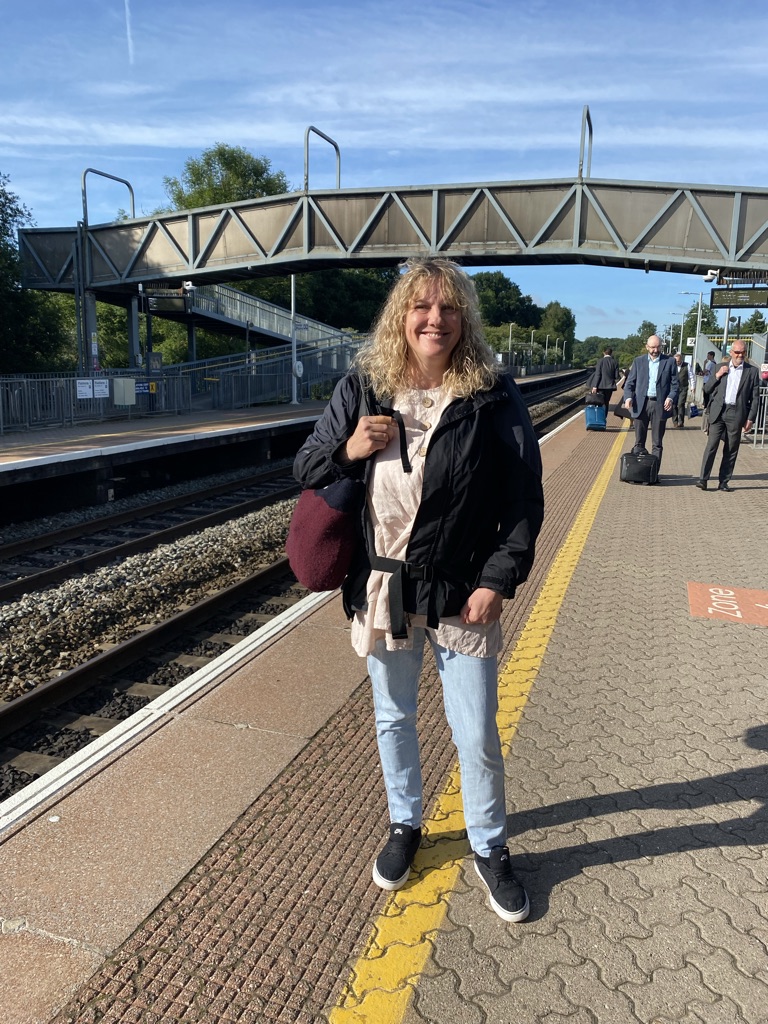
On 6th July 2022, Mum left North Devon to travel to Tijuana, she was heading to the Hoxsey Bio-Medical Center.
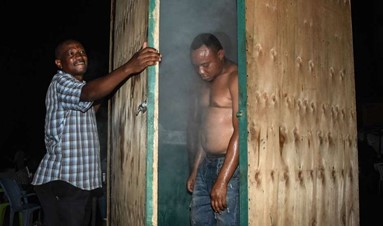
Once at the clinic, Mum was hooked up to an IV for five days that was full of vitamins and supplements, with the purpose to strengthen her impaired immune system. She was then given a herbal remedy called “Hoxsey Tonic”, which helped to detox her system. They also gave her a detailed diet plan with meal ideas because there were some foods that she had to avoid because they counteracted with her tonic. This tonic and diet plan became an integral part of the rest of her life. Details of how the Hoxsey Bio-Medical Center addresses cancer can be found here.
The Bio-Medical Center’s ‘About’ page states:
“Hoxsey Bio Medical was founded on a desire to share hope and help people heal… Since its inception in 1963, Hoxsey Bio Medical has allowed over 250,000 patients to face cancer on their own terms. Many of our original staff and trusted partners remain at the clinic, preserving the mission of empowering each patient to face their diagnosis with strength and stability.”
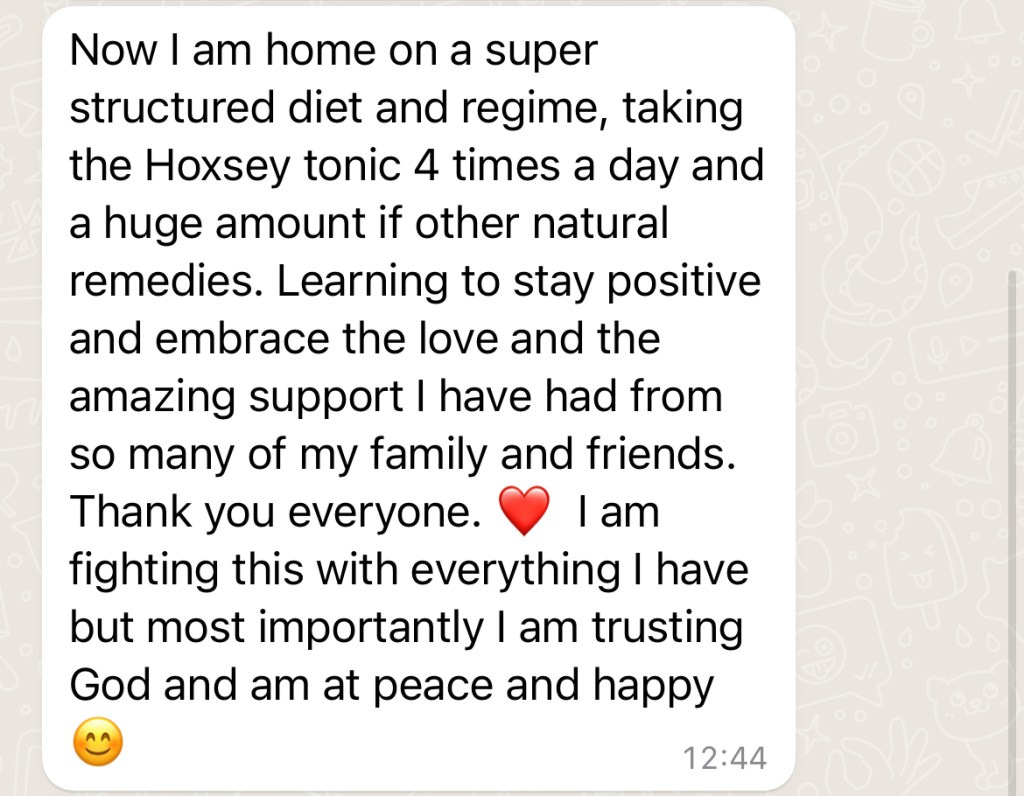
I truly believe that this is what they did for Mum. They empowered Mum to fight cancer in her own positive way. The hospitals she visited in England were responsive with her diagnosis and testing but Mum didn’t feel heard or seen. As soon as she spoke about alternative methods of approaching cancer, she was often demonised and neglected. Whereas, below is a message I received from her once she’d returned from Mexico:
What do I think about all of this?
Now you may be wondering how I feel about all of this? Mum has of course died now, so she was not healed by these alternative methods, or God. I think the most important thing to recognise is that this was never promised – through either conventional or alternative treatment.
Mum was terminal and, unless done miraculously, she wasn’t going to be healed. However, she was able to fight cancer in her way. Because of her strong opposition to chemo, I truly believe that she would not have responded well to it. Whereas because Mum had the freedom to fight cancer in this alternative way, she was full of life, up until the very end!
The doctors gave her a prognosis of a few months without their treatment, but Mum lived for another year and three months! And you wouldn’t have even known she had cancer until her very final couple of months.
The path she took also helped her to grow in her faith. She saw an opportunity to trust God, to look at the natural world he created and to recognise it’s goodness and healing properties. She died with dignity, hope and faith, knowing that she did all that she could to fight the horrible disease that she had.
Furthermore, through Mum’s cancer journey – from completely changing her diet, to following her gut and fighting her disease in her way, to deep diving into the alternative ways to fight cancer – I really recognised what an amazingly strong, determined and resilient woman she was. I’m so grateful to be able to call her my mum and for the resilience and trust in God that she has taught me.
“He has made everything beautiful in its time. He has also set eternity in the human heart; yet no one can fathom what God has done from beginning to end.” (Ecclesiastes 3:11)
 GRACEFULL REFLECTIONS