Out with the conventional, in with the alternative: Fighting cancer with alternative medicine


I think it’s safe to say that the word “conventional” was never used to describe Mum. She viewed life through a lens just a little bit different to everyone else’s and it was often very beautiful. But I think the area where her unconventionality was most evident was when addressing health. 

When I was about 8 years old, I clearly remember Mum claiming that if she ever had cancer then she would refuse conventional treatment (like chemo), fly to Mexico and go to an alternative medicine centre there. Little did I know just how accurate this statement was. 

Making big decisions

When Mum was diagnosed with cancer, she spoke to the doctors about the different treatment options, but I knew exactly which medical path she would take. As you would expect, she received a lot of push back from medical professionals and friends, it’s not often people decide to take on cancer in the way that she did. 

I remember saying to her that whatever decision she makes, I’ll support her. I also felt the need to point out that if she did change her mind and wanted to go down the conventional route, then that’s ok too. 

But essentially, doctors told Mum that she would likely die in around three months without any medical intervention. They said that with their treatment, there was a 65% chance she would live for a few more years. Understandably, those figures were not enough to convince Mum.

We were also very aware that the information given by doctors was not definite. No human can be sure. But we have a God that knows the exact number of minutes we have left on this earth, and Mum chose to trust Him instead. 

The alternative route

So it was decided. Mum was going to fight her cancer naturally. She had been watching a video series called “The Truth about Cancer”, which looked at cancer through a range of lenses, such as emotional, dietary, biological. This is something that really helped her. I think it made her feel like she was approaching her disease in a way that resonated with her. She would come back from the hospital feeling depressed and discouraged but these videos brought her hope and filled her with life. 

From the day she got her cancer diagnosis, Mum radically changed her diet. She cut out all sugar – this was a massive feat for her because she was definitely a chocoholic – but she believed that cancer fed off of sugar and it would make her more ill. And so, other than the odd special occasion, she cut it out!  

The next step was finding somewhere that would help her fight cancer in the way she wanted to. 17 years before her diagnosis, Mum had heard about a clinic in Mexico called the Hoxsey Bio-Medical Center. This is where she knew she wanted to go. But it would cost money. 

On 13th June 2022, we set up a GoFundMe page with the aim to raise £3,000, which would pay for her travel costs and treatment. In less than a month we reached our goal. And I would like to take this opportunity to thank each and every person that donated. Your generosity was astounding. I know that it really touched Mum, and she was overwhelmed with appreciation.

The Hoxsey Bio-Medical Center – Tijuana, Mexico
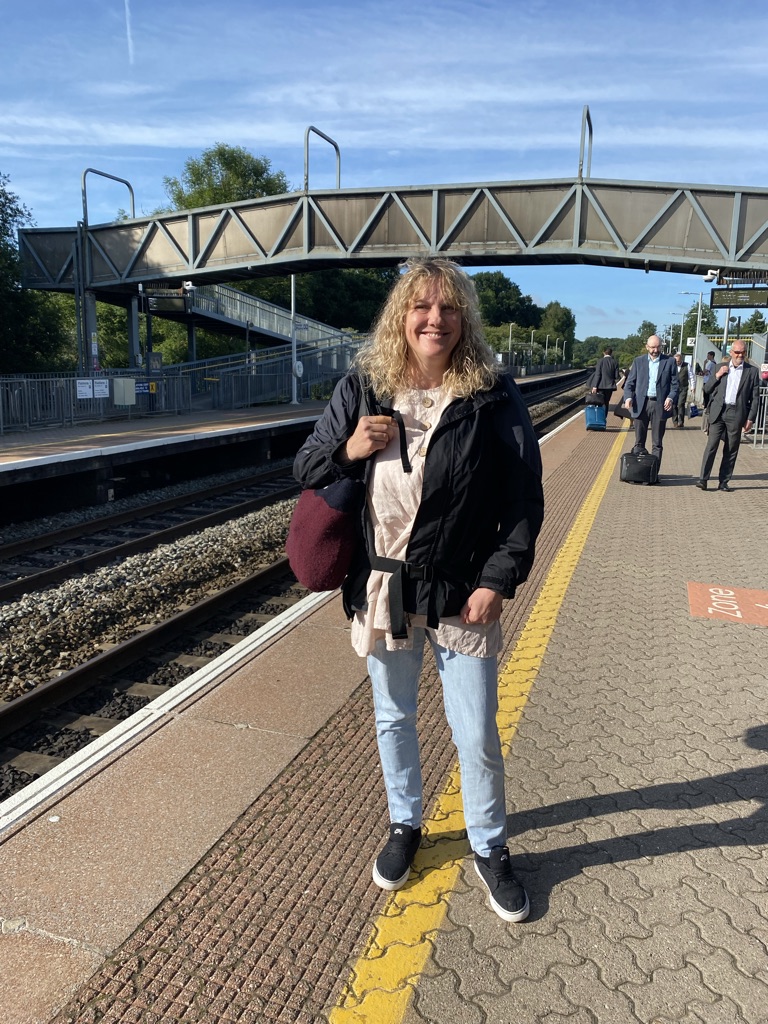
A picture of the author's mother stood on a platform, waiting for a train to travel to Mexico for alternative treatment.
Mum leaving to travel to the Hoxsey Bio-Medical in Tijuana, Mexico (6th July 2022)

On 6th July 2022, Mum left North Devon to travel to Tijuana, she was heading to the Hoxsey Bio-Medical Center.

Once at the clinic, Mum was hooked up to an IV for five days that was full of vitamins and supplements, with the purpose to strengthen her impaired immune system. She was then given a herbal remedy called “Hoxsey Tonic”, which helped to detox her system. They also gave her a detailed diet plan with meal ideas because there were some foods that she had to avoid because they counteracted with her tonic. This tonic and diet plan became an integral part of the rest of her life. Details of how the Hoxsey Bio-Medical Center addresses cancer can be found here.

The Bio-Medical Center’s ‘About’ page states:

I truly believe that this is what they did for Mum. They empowered Mum to fight cancer in her own positive way. The hospitals she visited in England were responsive with her diagnosis and testing but Mum didn’t feel heard or seen. As soon as she spoke about alternative methods of approaching cancer, she was often demonised and neglected. Whereas, below is a message I received from her once she’d returned from Mexico:
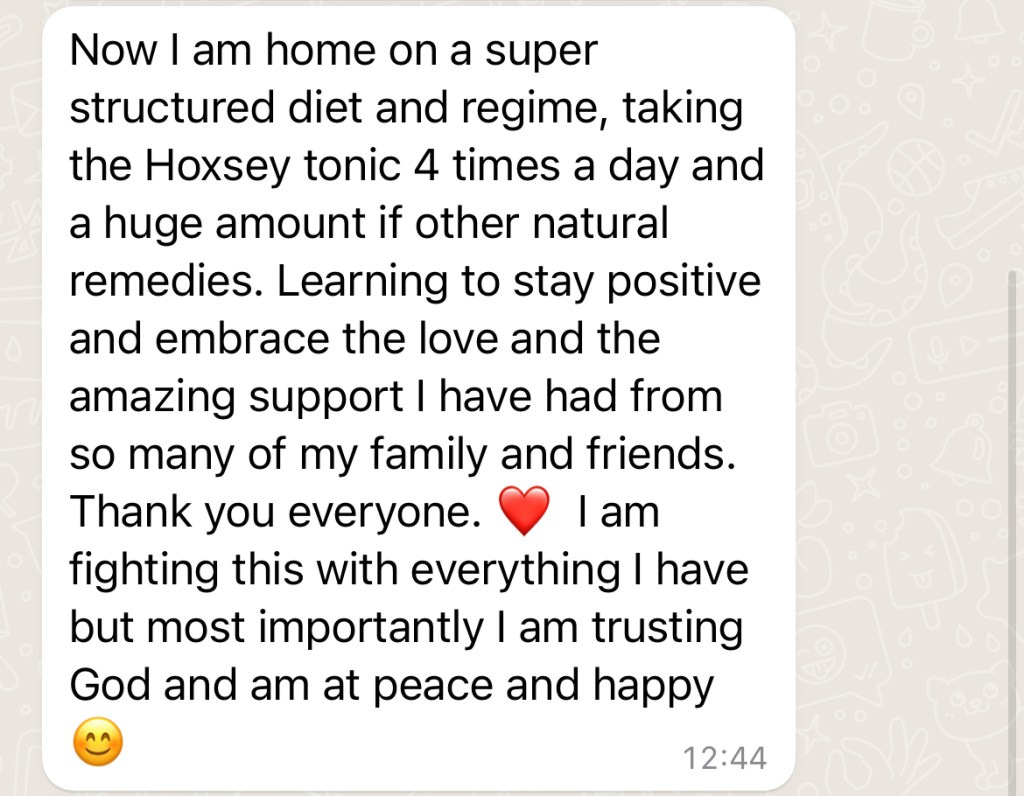
A WhatsApp message from the author's mother, describing how positive she was feeling after her alternative treatment.

What do I think about all of this?

Now you may be wondering how I feel about all of this? Mum has of course died now, so she was not healed by these alternative methods, or God. I think the most important thing to recognise is that this was never promised – through either conventional or alternative treatment. 

Mum was terminal and, unless done miraculously, she wasn’t going to be healed. However, she was able to fight cancer in her way. Because of her strong opposition to chemo, I truly believe that she would not have responded well to it. Whereas because Mum had the freedom to fight cancer in this alternative way, she was full of life, up until the very end! 

The doctors gave her a prognosis of a few months without their treatment, but Mum lived for another year and three months! And you wouldn’t have even known she had cancer until her very final couple of months. 

The path she took also helped her to grow in her faith. She saw an opportunity to trust God, to look at the natural world he created and to recognise it’s goodness and healing properties. She died with dignity, hope and faith, knowing that she did all that she could to fight the horrible disease that she had.  

Furthermore, through Mum’s cancer journey – from completely changing her diet, to following her gut and fighting her disease in her way, to deep diving into the alternative ways to fight cancer – I really recognised what an amazingly strong, determined and resilient woman she was. I’m so grateful to be able to call her my mum and for the resilience and trust in God that she has taught me. 

He has made everything beautiful in its time. He has also set eternity in the human heart; yet no one can fathom what God has done from beginning to end.” (Ecclesiastes 3:11) 
Responding to a Cancer Diagnosis: The beginning of Mum’s battle with cancer


Here I am writing again, look at me go! I guess the tips from my last post have been somewhat effective. Something else that helped me schedule in time to write was starting to think about what I would write, which I found rather difficult at first. I have a lot to write about, but how to communicate it in an orderly fashion, that’s the challenge. 

Well, as I mentioned before, my last year or so has been particularly eventful so I thought I’d start at the beginning of that – my mum’s cancer diagnosis. Some tough stuff to talk about but I think it’ll be good to reflect on it, and I pray that my experience can be helpful to others too. So here we go…

10th May 2022

Mum had a lump. It turns out she had had a lump for quite a while but due to the busy-ness of life, and the chaos of the ‘Covid years’, she didn’t go to get it checked. In the months of March – April 2022, Mum was changing career from co-ordinating expeditions up Kilimanjaro to training to be a taxi driver – quite the dramatic change. This seems irrelevant, I know, but this shift of career was more life changing than you can imagine. To become a taxi driver, there are all sorts of tests you need to do – including medical. During her full body examination, Mum’s lump was found. 

A small reflection on this: God really does work in mysterious ways. What a random change of career – expedition co-ordinator to taxi driver. But if it wasn’t for the providence of this timing, who knows when Mum’s diagnosis would have come about.

So anyway, at this point all we knew was Mum had a lump on her left breast and it needed to be checked. On 10th May 2022, Mum had a confirmed breast cancer diagnosis that was “at least” at Stage 3 but we were waiting for further test results. These results later confirmed that Mum was HER2+, meaning that the cancer would grow more quickly. A month later, it was discovered that the cancer was at Stage 4 because it had spread to her lymph nodes on the right side. 

Responding to a diagnosis 

A diagnosis effects many people in many ways. As soon as there was any mention of cancer, I sought advice from online resources and found Macmillan’s “Supporting Someone” page particularly helpful – it really talks through the emotions of the person receiving a diagnosis, which is useful to understand if you want to support them well. Personally, I feel that I responded in the following ways: 

  1. Being there – My mum lived in North Devon and I live in Bath – sometimes being there didn’t mean physically. Even before a confirmed diagnosis, I phone and messaged Mum regularly. I wanted her to feel supported and seen. I travelled down on the day of her diagnosis, and then rather regularly as her journey transpired. It was important to me that Mum knew she wasn’t going through this alone.

  2. Research – There’s a lot of terminology that comes alongside a diagnosis. This can be confusing. There is also a lot of information on the internet – plenty of which can be rather unhelpful, and cause more anxiety and fear than is needed. I did research terminology to gain a basic understanding, but I tried to not go down any rabbit holes of what symptoms and longer term prognosis looks like. I felt that the most important research I could do was practical stuff. How can I support Mum emotionally? What’s helpful and unhelpful to say? What are the likely emotions I will feel during this time, and how could I process these?

  3. Faith and prayer – In moments of such uncertainty the only way I know how to respond is by praying – and when I say praying, I don’t mean praying that this bad thing will go away. I mean praying that God will give the strength to get through such a storm. Recognising through prayer that I know God sees past these current events, and He will carry me through to the other side. Praying that Mum will remember who God is and that He’ll be with her when everything feels dark and scary. To pray such things, had wondrous results. I had to keep reminding myself that death, pain and suffering is not the way that God wanted this world to be, and it pains Him as much as it pained me. This scary situation was an opportunity to draw closer to God, who wants to comfort and love me through such situations – what a hope to hold on to.

  4. And finally, choosing love – This is going to be a recurring theme as I discuss Mum’s cancer journey because during this whole experience, I think I’ve learnt the many forms that choosing love can take. I also learnt that the best way to know how to love Mum and the people around me, was by remembering who Jesus is and how He chose to love me. To love well, you must take a real look at your own heart, where your intentions lie, and who you are doing things for. Sometimes choosing to love someone means saying the hardest truths, sometimes it means not saying anything. But overall, I knew that the best way I could love Mum during this devastating time, was by pointing her to Christ and the love that He has for her. 

As I said above, a diagnosis affects many people in many ways. It’s tough news to receive and nobody responds perfectly. I’ve not written this to tell anyone what they should or shouldn’t do. I just want to reflect, process and share my story of how I responded during a pretty tough time. 

I shared the below verses with Mum on the day of her diagnosis, and how true they remained throughout her cancer journey: 

“For I am convinced that neither death nor life, neither angels nor demons, neither the present nor the future, nor any powers, neither height nor depth, nor anything else in all creation, will be able to separate us from the love of God that is in Christ Jesus our Lord.” Romans 8:38-39

Follow my story…

If you would like hear more of my experiences and reflections, sign up and stay up to date.

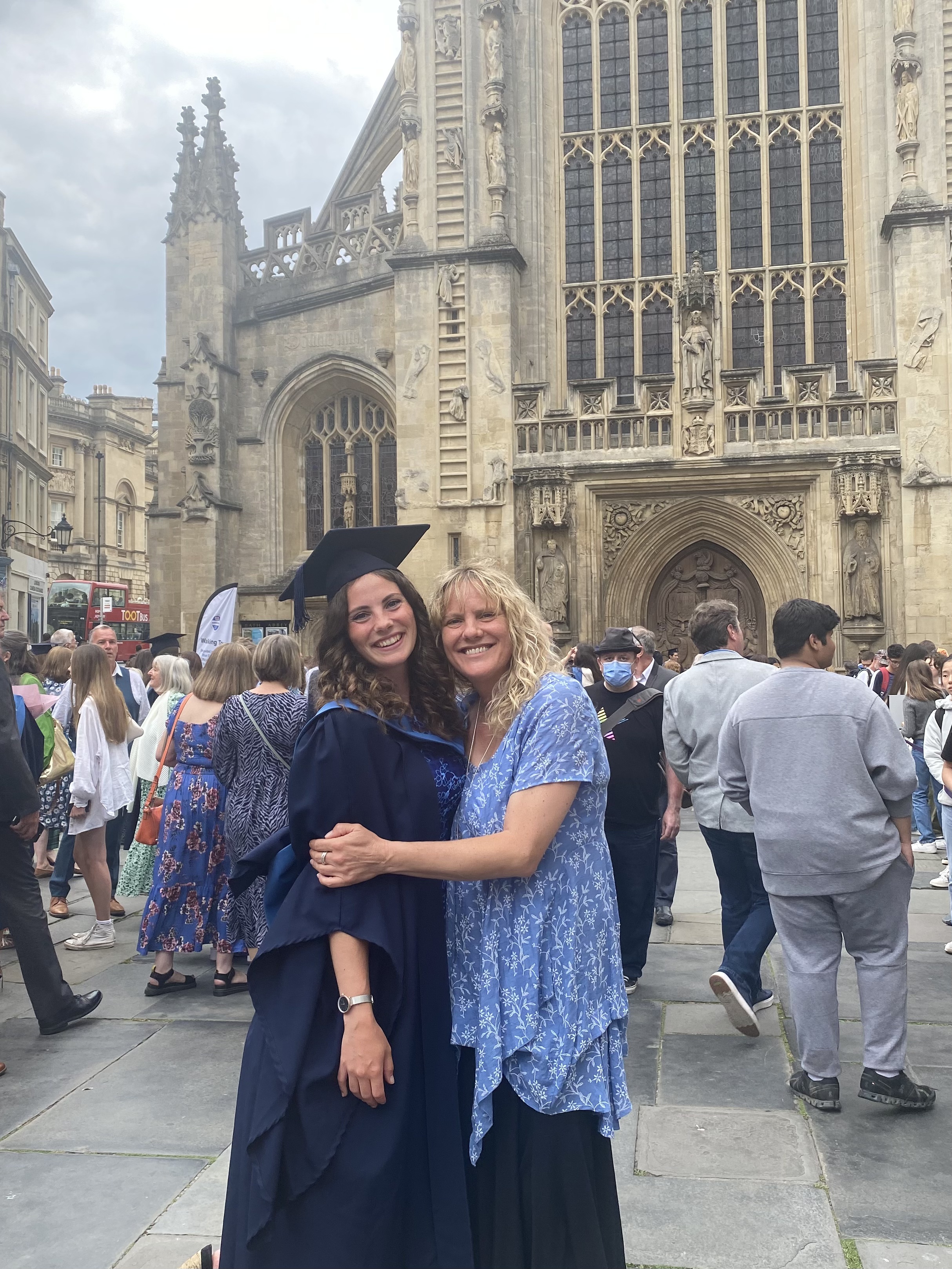
A picture of the author in graduation attire with her mother that has passed away, stood in from of Bath Abbey.

Water and Your Wellbeing

It is suggested that we aim to drink 6-8 glasses of water a day, this amounts to around 1.2 to 1.5 litres. So why is it so important that we drink water and how does it affect our wellbeing?


I can be the first one to admit that I definitely don’t drink enough water. I try to bring it into my daily routine, but it’s very easy to forget. This is why I think it is important to remind ourselves of the benefits of drinking water and how it can impact our overall wellbeing.

Brain functioning and energy levels

Drinking water keeps you hydrated, so when you’re not drinking enough of it, it can negatively impact your productivity and general mood. Studies have shown that fluid loss (which can occur during everyday activities) impacts:

  • Mood
  • Concentration
  • Memory
  • Frequency of headaches
  • Anxiety and tiredness levels

I can tell that I’ve not been drinking enough water when I have difficulties concentrating on work. Similarly, whenever I feel a headache coming on, I immediately go and drink a pint of water.

A headache is one of the most common symptoms of dehydration and for some, this frequently results in migraines. Studies have even suggested that drinking water can reduce headache frequency in people that suffer with them.

Water and your mental health

Research has shown that there is a connection between drinking enough water and having good mental health. Being dehydrated may well increase your risk of depression and anxiety.

According to Healthline, a study in 2018 showed that drinking more water lowered the risk of anxiety and depression. The connection between dehydration and depression was stronger, but results showed that anxiety levels were higher in those that weren’t drinking enough water.

When I struggled with anxiety and panic attacks a few years back, I took a look at what I was putting into my body. When buying a snack, the first thing I would go for was a chocolate bar and a Lucozade sport, or a fizzy drink. I made a conscious decision to change this and started buying water and fruit instead. I think that this was one of the most important steps I took in fixing my mental health.

Looking after your skin

Skin is the largest organ in your body, it only makes sense to keep it hydrated. Drinking enough water is a natural way to get the glowing and healthy skin that we’re all looking for.

If you are someone that suffers with spots or acne, then it is super important that you’re drinking enough water! Spots are caused by toxins clogging up your pores. Drinking more water keeps your skin hydrated and therefore minimises clogging.

Furthermore, keeping your skin hydrated helps to maintain its elasticity. Drinking large amounts of water decreases scars, wrinkles, and soft lines, meaning that signs of aging are lessened. As you get older, it will be more difficult for your body to retain water, making it crucial to ensure you are drinking enough of it now.

I like to picture my skin as a piece of fruit – once they are dehydrated, they become coarse and wrinkly. Who wants to be a shrivelled-up raisin? Not me!

Weight loss

There are so many reasons why drinking water aids weight loss! I think this section is in need of some bullet points:

  • It is a natural appetite suppressant – often we think we are hungry, when really it is likely that we need some water. Similarly, water takes up space in our stomach, leading to reducing hunger and leaves you feeling full.
  • Water increases calorie burning – this can be during exercise or resting. Drinking cold water further enhances this as the body uses up energy/calories by heating up the water to digest it.
  • Aids digestion and helps to remove waste from the body – drinking water helps to filter your kidneys and minimises constipation, keeping everything down there flowing smoothly.
  • Reduces calorie intake – as water has no calories, drinking just water rather than all the other drinks out there means that you are minimising your overall calorie intake.
  • You need water to burn fat – without drinking water, your body is unable to break down fats and carbohydrates. In fact, drinking plenty of water increases your metabolism.
  • Working out – it is imperative that we drink water before, during and after our workouts. It helps the lungs, heart and other organs to function, and also helps muscles, joints and connective tissues to move correctly.

Drinking water when you’re ill

It is crucial that you are drinking enough water when you’re sick. First of all, sweating, fevers and running noses all increase body fluid loss, which may well lead to dehydration. Furthermore, drinking plenty of water relieves congestion and loosens the mucus in your nose, pushing you towards a speedy recovery. Similarly, staying hydrated helps the body’s overall functioning and means that it is better equipped to defends itself against illness.

There are many more benefits of drinking water, but these are the ones that I feel are most influential on our overall health and wellbeing. I do hope that this has spurred you to want to drink more water, because it is honestly so important for us! Now don’t mind me, I’m off to grab a glass of water!


Image credit: Camille Brodard via Unsplash

Traditional medicines: Tanzania’s alternative approach to treating COVID

Renowned in the Western world as Tanzania’s “COVID-denying” president, John Magufuli’s response to the global pandemic has been a surprise to many.


Tanzania last updated the World Health Organisation with COVID cases and death statistics on 8th May 2020. Reuters has reported, “President John Magufuli’s sceptical approach towards COVID-19 has caused alarm among WHO officials”.

Tanzania’s response to COVID

Magufuli’s initial response to the pandemic had been one of emergency. However, after a pawpaw fruit and goat tested positive for COVID, the president declared doubts on the accuracy of tests imported from abroad.

Although reports describe Magufuli as COVID-denying, this does not seem to be the case. Safety measures, such as hand sanitisation, mask-wearing and social distancing, are in place in Tanzania.

Official documents, such as the National Park’s COVID-19 Health and Safety Standard Operating Procedures, provide details on Tanzania’s COVID guidelines.

However, the president has not put the country into lockdown and measures are not mandatory, just recommended.

Many Tanzanians have supported Magufuli in his response to COVID. Local mountain guide, Faraja Mwaijande, 45, shared:

“President Magufuli didn’t lockdown the country because most of Tanzania are working to get our daily bread, as we don’t have sustainable income, which was a good move.

“From my point of view, our government did a great job… here in Tanzania, we follow COVID guidelines, but we are not fearing, which makes us feel free and keep working and living normal life.”

John Leonard Minja, 34, has also commented, “COVID exists, and precautions must be taken while fighting to earn our daily bread, for if we don’t keep on with life, death shall be there via hunger and other life-threatening agents.”

Has this been detrimental for Tanzania?

Reuters reported, “The United States said that Tanzania… is experiencing a surge in COVID-19 cases and its healthcare facilities could be quickly overwhelmed”.

When asked to comment on this subject, Mwaijande said that hospitals “[…] are not overwhelmed, just normal. We are not in a bad condition like Western media says.”

He also shared, “Many people get symptoms of Corona and get cured, but very few have died from COVID.”

There is no cure to COVID, however, Magufuli has been an advocate of combatting it using traditional treatments; specifically steam inhalation, known as ‘kufukiza’ in Swahili.

When asked if people in Tanzania are still contracting COVID, James Nasary, 26, responded:

“Of course, especially those who live in high population… now people know how to live with the disease, by using local medicine… these remedies combine different trees.”

However, he went on to add, “But in my personal opinion, I do not recommend these because research has not been done by health professionals.”

Traditional medicine has been a part of Tanzanian culture for centuries. Different natural treatments are used depending on the traditions of a tribe.

Mwaijande, a Nyakyusa tribesman, explained:

“People in villages have traditional healers, they know plants and roots that you can use to treat most illnesses.

“If you get cold or other flu illnesses, they will use a steam incubator by boiling eucalyptus leaves and other plants. We have quinine tree that you cut bark off, boil it and drink it, which is treatment for Malaria.”

But not everybody is convinced. In his blog, Shauji Saidi Mpota, states:

“Despite the government reporting that there have been no cases of the coronavirus in Lindi region… myself and a significant majority are of the view that it still exists in our region, but at a small rate compared to the early months.”

As there is no data available on Tanzania’s COVID statistics, it is difficult to determine how successful the country has been in combatting the virus. Nevertheless, Tanzania has a strong, cultural heritage that it is now relying on in these difficult times.

Tanzanian hospitals, Muhimbili National Hospital (MNH) and Mloganzila, have installed steam inhalation machines to help combat COVID. PHOTO via Daily Monitor

­­­­I wrote this article in April 2021 for an International Journalism module. We were tasked with writing a 600 word piece on a country and topic of our choice.

Mental health and the wonders of walking

If growing up in the countryside has taught me one thing, it is the importance of being in nature. My childhood memories are filled with walks in the woods, mud fights and trips to the beach. Now living in a city, it is often very difficult to escape the hustle and bustle of everyday life and this can really take a toll on my mental health.

I often experience days of feeling slumped, stressed and sluggish. My motivation hits rock bottom and it’s a lot harder to look on the brighter side of life. I have found that a very simple fix for this is to go for a walk and in doing so, observing and being aware of your surroundings.

Exercise and your mental health

It is common knowledge that exercising is good for your mental health due to the physical, mental and social benefits. Getting your body moving and increasing your blood flow produces endorphins, your body’s “happy chemicals” that relieve stress and pain. Going to the gym or doing aerobic exercises, such as jogging, swimming and cycling, are proven to be effective in reducing anxiety and depression.

However, often we do not have the time (and admittedly, effort) to go to the gym or take part in a full aerobic workout. This is where I find walking a much easier and enjoyable way of exercising.

The importance of walking

The UK Chief Medical Officers’ Physical Activity Guidelines recommends that adults aged 19-64 should undertake at least 150 minutes of moderate physical activity a week. This may sound like a lot but only amounts to 30 minutes of walking, 5 days a week. It is also recommended that children and young people aged 5-18 should engage in physical activity for around 60 minutes a day – hence why PE is such an important part of schools. Regular walks will:

  • Lower blood pressure and enhance performance of the heart, lungs and blood circulation
  • Reduce the risk of heart disease and strokes
  • Help maintain weight and therefore improve body image
  • Reduce the risk of illnesses, such as diabetes and cancer
  • Improve the strength and flexibility of muscles, bones and joints
  • Boost your immune system
  • Improve your mental health by lifting your mood, encouraging healthy sleeping patterns and reducing stress and anxiety

Science aside, I find walking has a calming effect as it is a wonderful way to connect with your surroundings. Pay attention to the goings on around you. Watch the squirrels scampering and the leaves falling from the trees. Feel the wind blow through your hair and against your skin. Listen to the laughter of children in a nearby park and birds tweeting in a towering tree. Smell the freshly baked bread as you stroll past a bakery. Often, paying attention to these simple things will pull your mind away from stressful thoughts and feelings. 

‘10 minutes matter’

Now, some of you may be thinking that as nice as regular walks may sound, your schedule is way too busy to be able to fit them in. If this is the case (and even if not), then ‘10 minutes matter’ walks may be just for you.

The idea behind this concept is that each day you schedule in 10 minutes of walking downtime. We live in a busy world, full of demands, stresses and technology. Taking a 10-minute walking break from work can boost productivity. For even better results, why not leave your phone or any technology at your desk? This may make you feel uncomfortable in the beginning but it is a very beneficial habit to adopt. 

You may prefer to take part in this downtime with a friend, which can be great motivation for yourself and them. However, the only rule is that you are not allowed to talk about work or other stressful factors. Spend this time enjoyably, laughing and talking about positive things.

The purpose of this technique is to minimise cognitive boredom, which occurs when you perform repetitive tasks for long periods of time. Integrating these practices into our life enables us to rest and recharge, boosting creativity and diminishing stress.

Short walks encourage blood flow and keep us mentally sharp. They are a secret weapon that we should all be utilising. England’s Chief Medical Officer, Sir Liam Donaldson, agreed with this by stating, “If a medication existed which had a similar effect [to physical activities, like walking] it would be regarded as a ‘wonder drug’ or a ‘miracle cure’”.

A closing note
The charming colours of autumn

At this time of year, many people start to experience Seasonal Affective Disorder (SAD), this is a type of depression that occurs during certain seasons. With winter looming around the corner, you may be starting to feel uneasy about this. My advice would be, as hard as it may seem, get outside and go for a walk!

Absorbing vitamin D through natural light is one of the most beneficial ways to overcome SAD. Plus, once you are outside it is a wonderful experience. The colours at this time of year are amazing and the change of leaves and seasons is a beautiful thing to witness.

A conversation about Epilepsy

There are over 500,000 people with epilepsy in the UK alone, so why is there not a greater awareness of the condition?

The first time my younger brother had a seizure, he was in class at school. I was in a history lesson at the time and was called upon to go to him. I ran to his classroom where his teacher looked unsettled. She had initially thought he was playing around and had told him off. A few days after the incident, another teacher was overheard saying to a colleague that he hoped my brother falling over had “knocked some sense into him”.

After being given tests and scans, my brother was soon diagnosed with Focal Onset Secondary Generalised Epilepsy in the left temporal lobe of his brain. We learnt that his brain was having constant spikes. At school he was often told off for not concentrating or writing down homework and was labelled “one of the naughty kids”; when in fact, due to his neurological disorder, epilepsy, he was having constant miniature seizures and this is why he struggled in lessons.

The school took a proactive approach to my brother’s experience. They carried out a course on epilepsy, endeavouring to spread awareness of the illness across the teaching staff. However, this is something that has had a profound impact on my younger brother’s life and I wonder, if there had been a greater understanding of epilepsy in schools, would my brother have had to suffer in this way? The school could have recognised signs of epilepsy, rather than assuming laziness and incompetence.

Figure 1 shows an average person’s EEG results. Figure 2 shows my younger brother’s EEG results. Both were taken whilst the patients were resting.

What is Epilepsy?

Epilepsy is a complex neurological condition that has physical, mental and emotional consequences on those who suffer from it. One is only diagnosed with epilepsy once they have had recurring seizures that stem from the brain. A seizure occurs when there is a sudden interruption to the brain’s neurones that causes an abnormal response. Not all seizures are caused by epilepsy but there are over forty different types of epileptic seizures – this is what makes it such a complex condition. As there are so many types of seizures, each person is affected by, deals with and recovers from them differently.

Many people are mistaken in thinking that epilepsy is something that will not affect them in their lifetime. But the scary truth is that anybody can develop epilepsy at any point of their life. No matter your age, race or social class, you or a loved one could experience epilepsy. Current statistics show that there are over 500,000 people with epilepsy in the UK alone, this is approximately 1 in 100. Over 65s and children are the most common to be diagnosed with the condition. As epilepsy is such an intricate illness and can vary from person to person, the cause of an individual’s epilepsy can be difficult to determine. However, the most common causes are head injuries, difficulties during birth or genetic inheritance.

Thankfully, due to extensive knowledge and understanding of epilepsy among professionals, seizures can usually be controlled by medication. Additionally, as epilepsy is often triggered by pubescent change, it is common for children to outgrow it. However, in very extreme cases, SUDEP is a daunting possibility within the illness. SUDEP stands for Sudden Unexpected Death in Epilepsy and affects approximately 1 in 1000 people with the disorder.

A call for education

During the 21st Century there has been an increase in awareness and understanding of medical conditions and illnesses across society. So why is there an underlying ignorance when discussing an illness as diverse and severe as epilepsy? Mental health and well-being are now a major part of school systems, however, there seems to be an absence of discussion regarding illnesses like epilepsy.

Results of a survey created as research for this article indicate that although 100% of the people knew what epilepsy is, 85% did not recall the topic being discussed in their schools. Only 52.5% of the survey participants would know what to do if somebody was having a seizure, and just 35% know about the different types of epilepsy and seizures.

One participant commented, “My school did not touch on epilepsy at all, all children should be educated on how to deal with epilepsy as it can help protect their friends or people they might meet in the future”.

Similarly, another participant shared, “I was never taught about it and it would of been helpful to know, but I taught myself how to handle it from the internet and NHS guidelines that I looked at”.

Results of an epilepsy awareness survey created as research for this article.

The importance of raising awareness

There are many reasons for why schools should raise awareness and education of epilepsy. As the condition can be developed by anybody and there are no physical signs of the illness, it is crucial that there is some sort of basic understanding across society. When somebody has a seizure, it is a very scary experience – both for the individual with epilepsy and the people witnessing it. If there is a basic knowledge of what to do when somebody has a seizure and an understanding of why this is happening, the experience becomes less frightening. This enables the individual to come around from the seizure in a calm and safe environment.

Additionally, epilepsy has a detrimental effect on your mental health. It is common for an individual to feel a sense of loss or major restriction once they have been diagnosed with epilepsy, as it is such a life changing condition. Often anxiety and depression go hand-in-hand with epilepsy, due to it having such restrictions on your life and the fear of losing control over your body at any point in time. Enuresis is a possibility during seizures, which can be difficult to deal with, especially if this happens during school in front of classmates. An understanding among your peers and being surrounded by people that are comfortable and supportive of a condition like epilepsy, can make all the difference in overcoming any mental health difficulties related to the illness.

­­­­Puberty and a change in hormones can trigger seizures in young people. The NHS states, “Around one child in every 200 has epilepsy, and while some will grow out of it, others won’t”. Similarly, in 2013 the National Institute of Clinical Excellence (NICE) estimated that “there were approximately 34,000 young people under 18 with a diagnosis of epilepsy and taking anti-epileptic drugs in England”. This shows the importance of the education and awareness of epilepsy in schools, as it affects so many young people across our country.

Bringing in mandatory awareness and education of epilepsy within our education system would mean that this information would be shared with famili­­es at home. Before long there would be a much wider understanding of the condition throughout our society.

Information and courses that are available for schools

There are many epileptic charities that work to support research, provide information, and offer help and advice for coping with epilepsy. Epilepsy Action, Young Epilepsy and Epilepsy Connections are charities that offer a range of courses and lesson plans that were created to raise awareness and education of epilepsy in schools.

“A very short session can convey so much information about what epilepsy is, what seizures are, what things can people do and not do when a seizure happens, and it can then be addressed very easily,” said Colleen Wilson, the Education and Outreach Worker for the Schools Project at Epilepsy Connections. “If we can give people knowledge and information across communities, it can have a positive impact on lives.”

“In my generation, there is a stigma and negative concepts about it [epilepsy], but you can get rid of that with the generation that is coming up.”

Colleen Wilson, Education and Outreach Worker at Epilepsy Connections

Wilson’s role is to raise awareness of epilepsy in school ­­communities in the Glasgow area. From April 2019 – March 2020, the Schools Project reached “914 primary and secondary school pupils; 360 primary school pupils (Assemblies); 18 Girl Guides group; 35 college students” and attended “3 x Curiosity Live events at Glasgow Science Centre”.

It is encouraging to see that there are such amazing projects in place to raise awareness of epilepsy. However, there is still a lot of work that needs to be done. Wilson shared concerns that available courses are usually sought once there has already been an epileptic incident within a school.

It is common for a child with epilepsy to be an “underachiever” and to be labelled a “naughty child” or “the cheeky one”, as the condition can have such diverse effects on an individual’s behaviour. This needs to be tackled. There should be a basic knowledge of epilepsy in place so that a school is already prepared to support and nurture an individual with epilepsy. This basic understanding throughout schools would mean that teachers could recognise these signs or symptoms before there are unmerited negative impacts on a child’s life.

Raising awareness is not only beneficial for an individual with epilepsy, but it makes the students and teachers of a school more comfortable. Three girls in my younger brother’s class cried when he had his first fit. The teacher was not equipped with the knowledge to deal with a seizure. Knowing what to do when somebody is having a seizure creates a calmer atmosphere and less disruption to a school day.

So please, be interested in this complex condition. Familiarise yourself with a basic understanding of epilepsy and it will have a positive impact on so many lives.

© Poppy Evans 20/05/2020 ­­­­


I wrote this article in May 2020 for a What’s the Story module. We were tasked with writing a 1,500-word individual story of our choice.