Personal Investigation Summary Brief

For this personal investigation, I have decided to expand my knowledge on how wildlife is  protected in Africa. I grew up often going to Africa and climbed the continent’s highest  mountain when I was 15 years old, so this topic is something that is close to my heart. My  initial thought on this project was to investigate the ivory trade and the effect this has had on  today’s population of elephants. I had recently watched a film called Holiday in the Wild and  was captivated learning about elephant sanctuaries and the work that they do. However, an  interesting conversation with a gentleman from Sudan sparked a change of direction in my  approach to this project. He said that the key to change was the education of poachers and  civilians in African countries. Many people in these countries are living in poverty and their  only source of income often means harming African wildlife. He believes that people need to  be taught the importance of these creatures and that keeping them alive would create more  money within their communities.  

My first source is a book called An African Love Story. The author of this book is Daphne  Sheldrick who is part of the David Sheldrick Wildlife Trust, which featured on a 2007 BBC  programme, Elephant Diaries. I started this book with the intention to learn about elephants,  their behaviours and how orphaned elephants are saved and released back into the wild to  conserve their population. However, as well as these insights, the book revealed much more  to me. The book takes you through Sheldrick’s life, from her great grandparents migrating  from South Africa to Kenya during the colonisation of Africa, to herself being born in Kenya  and growing up with regular adventures amongst Kenyan wildlife, to her and David  Sheldrick’s amazing work protecting wildlife and fighting poachers. As this source is a  narrative, there is a risk of unreliability as stories may be exaggerated to give greater effect.  Even so, it has given me a profound understanding of life in Kenya during the 20th Century,  the perspective of the people living there and how the poaching and hunting of Africa’s  wildlife developed. A passage of the book that sums this up perfectly is when Sheldrick  (2013, p.7) is talking of “how lightly my ancestors shot at animals” and explains, “Everywhere  there was wildlife … At the time no one ever imagined that any amount of shooting could  devastate the stocks of wild game, let alone all but eliminate it”.  

The historical context offered in the book sparked an interest into the effect that the  development of African countries has had on its wildlife. This led me to watch a range of  TED Talks on the conservation of African wildlife. Talks by Lucy King, Jane Goodall and  Moreangels Mbizah focused on community-led projects that endeavoured to keep peace  between wildlife and surrounding communities. These videos re-iterate my Sudanese  friend’s message, about the importance of education and working with people within  surrounding communities in order to conserve African wildlife. This source has given me  insight into the different projects that have ran or are still in place, for example: Okango  Wilderness Project, awareness and education projects in local communities, Elephants and  Bees, TACARE and Roots and Shoots. It is hard to tell from the videos how effective these  projects are, however, Goodall (2007, 14:33) seems adamant that once projects like  TACARE have helped towards “improving the lives of the people living around” animal  conservation parks, “they began to understand evermore the need for conservation”. After  watching these videos, I researched the speakers and the projects they talked about.  

This brings me to my next source, a comprehensive Beehive Fence Construction Manual, developed by Dr Lucy King in accordance with her Elephants and Bees project. The manual  gives detailed information on elephants and their relationship with people; the construction  and maintenance of beehives and fences; and beekeeping, including pests and parasites to  look out for. This source revealed to me a new perspective to this investigation. While we  often focus on the idea that poachers are the reason for the decrease in elephant  population, King’s manual (2019, p.5) talks of the conflicts between people in local  communities and elephants in surrounding areas, it tells us that “unfortunately both people  and elephants are sometimes killed due to conflict over resources.” The manual’s main aim  is to combat the conflicts between Kenyan farmers and elephants in a natural and humane way that will help to conserve the elephant population. I was drawn to this source as it has  such a wide range of information and is set out in a clear and coherent way that is easy to  understand and follow.  

Tanzania is renowned for its conservation of wildlife. To acquire a greater knowledge of how  the country protects its animals, I have spoken to an Expedition and Safari Co-Ordinator and  some of the safari guides from a Tanzanian tourism company, Team Kilimanjaro. I was  worried that their feedback may be biased, but they gave me lots of useful information and  even spoke about challenges the country still faces. Tanzania is made up of many National  Parks, and fees paid by tourists to access these places go towards looking after wildlife,  including in surrounding areas. Edgar (2020) highlighted the importance of “education on  people living near National Parks” – a recurring theme throughout this investigation. New  aspects have also been highlighted. Firstly, the Tanzanian government are involved in the  protection of the country’s wildlife and Edgar (2020) shared with me that they have put in  place “tough punishment to those who disagree” with the rules. Secondly, Edgar (2020) also  called to attention the issue that many “people living near animals environment used to do  poaching” as a living. National Parks have been instrumental in offering education, projects  and, most importantly, employment to students in surrounding communities. Maasa (2020)  claimed that offering these people employment minimises the number of poachers and these  same workers are also teaching villagers “the benefits of sustainable wildlife”. Screenshots  of these Whatsapp conversations can be found at the end of this report.  

I have thoroughly enjoyed investigating this issue. The sources I have used have given a  variety of different aspects and perspectives of the topic. I feel I started this project with quite  a narrow-minded view of African wildlife conservation and only thought of things from a  poaching aspect. However, I think I now have a broad view on the topic and have learnt  about the many aspects that come into play when discussing the complex conversation of  protecting African wildlife.

Bibliography

Anwer. (2020) Conversation with Poppy Evans, 8th March. 

Dr Lucy King [TED Talks] (2019) How bees can keep the peace between elephants and  humans. December. Available here (Accessed: 25/04/2020). 

Edgar, I. (2020) WhatsApp to Poppy Evans, 9th April. 

Evans, A. (2020) Telephone conversation with Poppy Evans, 5th April. 

Holiday in the Wild (2019) Directed by E. Barbarash. [Feature film]. United States: Netflix.

Jane Godall [TED Talks] (2007) How humans and animals can live together. June.  Available here (Accessed: 25/04/2020). 

King, Dr L. (2019) Beehive Fence Construction Manual. Nairobi, Kenya: The Elephants  and Bees Project. Fourth Edition. Available here (Accessed: 25/04/2020).  

Maasa, G. (2020) WhatsApp with Poppy Evans, 9th April. 

Moreangels Mbizah [TED Talks] (2019) How community-led conservation can save  wildlife. April. Available here (Accessed: 25/04/2020).

Sheldrick, D. (2013) An African Love Story. Great Britain: Penguin.  

Steve Boyes [TED Talks] (2018) How we’re saving one of Earth’s last wild places. April.  Available here (Accessed: 25/04/2020).
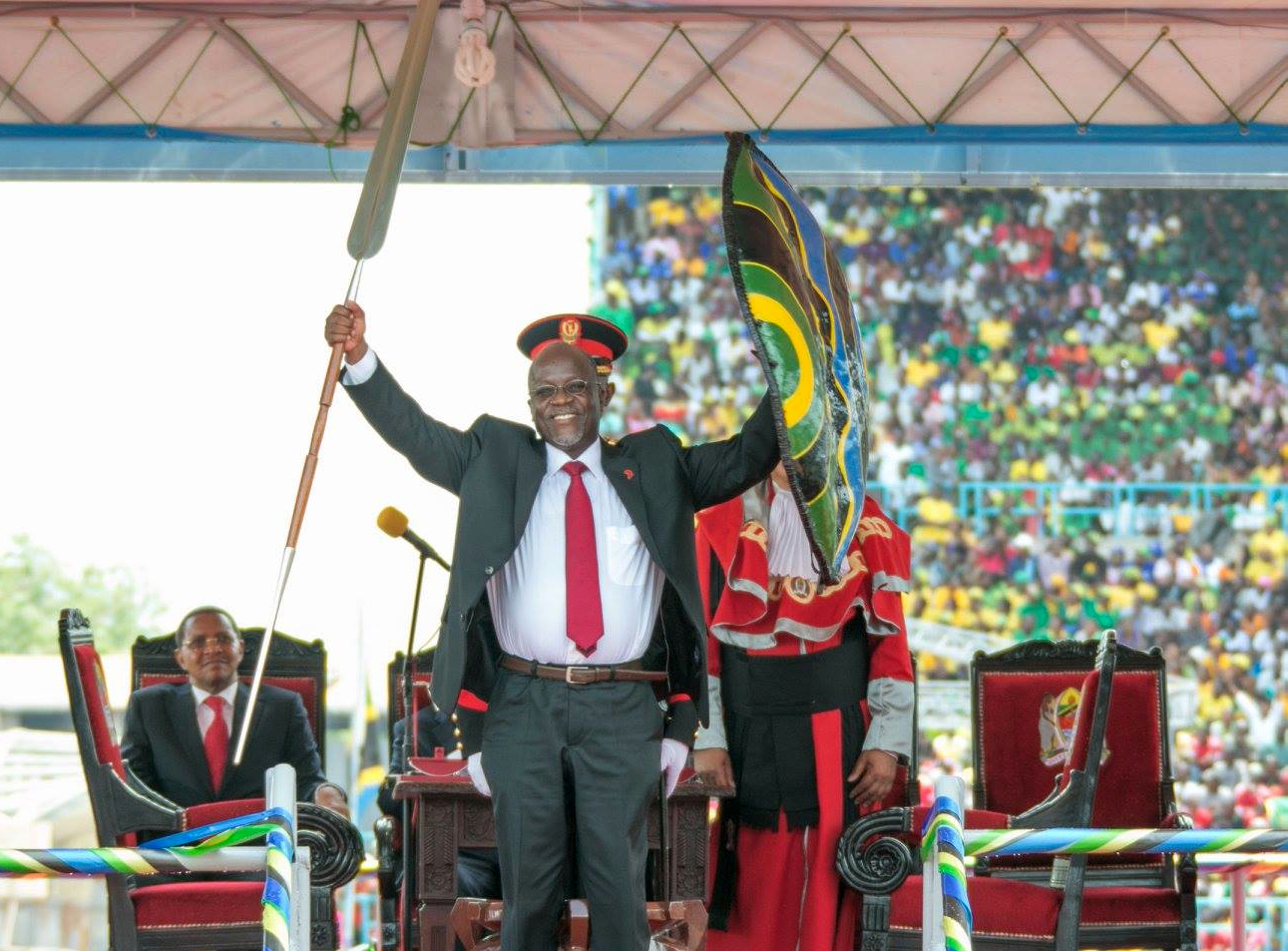
John Magufuli: The Life and Legacy of Tanzania’s Late President

“Mr President Magufuli was my man with a good heart to his people,” says local mountain guide, Faraja Mwaijande, of the late President of Tanzania, who died of heart complications on 17th March 2021.


Dr John Magufuli was a divisive figure within the governmental ranks, one citizen described him as “the president Tanzanians needed”. However, throughout his presidency he was heavily criticised and known by many as “The Bulldozer”.

But why the controversy? What was it about this man and his presidency that divided opinion throughout not only Tanzania, but the rest of the world too?

Tanzania under President Magufuli
“The Bulldozer”

When asked how Magufuli’s presidency impacted Tanzania, a local tour guide reported:

“The best of all is that he installed integrity in the entire society, from governmental heights to individual level with us as citizens.”

From the start of his presidency, anti-corruption was an important issue to Magufuli. As reported by Africa News in 2016, he “vowed to root out corruption in his ruling party, threatening ‘no mercy’ for anyone giving or taking bribes”.

Within days of becoming president, he was making big changes, such as cancelling Tanzania’s independence day fete and instead putting this money towards much-needed roadworks. He also fired many government officials in what the BBC described as his “anti-corruption crusade”.

It was his hard-headed approach that bestowed him the nickname, “The Bulldozer”. However, Tanzanians, and people throughout Eastern Africa, found admiration in his methods.

A man that loved his nation

Magufuli’s view on the relationship between the government and its citizens impacted many Tanzanians. Mwaijande claims that thanks to Magufuli:

“People know it is the responsibility of government office to help and solve problem on behalf of Tanzanian citizens… He was the best president of Tanzania after our first President Nyerere, in my opinion.”

Coming from a humble background, Magufuli wanted to help the poverty levels of Tanzania. James Nasary, a local guide, shared:

“President Magufuli grew up a labourer. In his lifetime he wanted to remove the strata of his people between the ‘haves’ and the ‘have nots’.”

Magufuli endeavoured to do this by enhancing the use of resources within the country and encouraging hard-work and dedication.

Mwaijande explains:

“You know, we have so many natural resources, but most local people didn’t know how we could benefit from them. Mr President Magufuli opened Tanzanian eyes to know we can get our shares from all big companies’ investment.”

Another citizen described:

“His motto was ‘hapa kazi tuu’, meaning working is the only valid thing. This boosted the nation’s spirit of labour to a level that Tanzania was last year announced by World Bank it has entered intermediate economy.”

This statement is supported by the World Bank, declaring:

“Following two decades of sustained growth, Tanzania reached an important milestone in July 2020, when it formally graduated from low-income country to lower-middle-income country status.”

Magufuli also focused on trying to optimise structures within Tanzania. Nasary, explains:

“[He] build country infrastructures, healthy centres and he was trying to unite East Africa countries in business alliance and development to each other… He trusted that citizens could build their own country… He build the capital city in proper way in terms of roads, electricity railway and tried to build Dar es Salaam as business city. Also, Magufuli build international airport in Chato in order to widen tourism sector in Northern parts.”

So, why the controversy?

Amongst the good intentions he had for Tanzania, he has been heavily criticised and often described as a dictator. This has been brought about by a range of policies and bans that he put in place:

Media restrictions

One of the greatest criticisms of Magufuli is his censorship of media. The BBC reported that Magufuli “muzzled Tanzanian media, shutting down several newspapers, radio and TV stations as well as social media platforms simply for reporting what the government didn’t like.”

Due to these restrictions, Tanzania ranks 124/180 on the 2021 World Press Freedom Index.

Travel restrictions for public servants

In November 2015, Magufuli limited foreign travel to emergencies only for all public officials. By 2019, this policy was relaxed, but they could only travel with a permit.

This strategy was in place to reduce government spending, and the BBC reported that:

“A central bank report in early 2017 revealed that the government had saved $430m (£330m) by limiting foreign travel between November 2015 to November 2016.”

Pregnant schoolgirls

In Tanzania, schoolgirls are expelled if they fall pregnant. Although Magufuli has been widely criticised on this issue, it was in place for four decades before his presidency.

However, when there was opportunity to nullify the policy, Magufuli did not go through with it. This caused division within his government.

Political rallies

From the start of his presidency, Magufuli was clear that he did not want political leaders initiating rallies. The BBC reported:

“He argued that people should be left alone to focus on ‘building the country’, and political leaders should wait for the next election in 2020 to hold rallies.”

This did cause concern amongst some citizens, as one shared, “…he also almost killed democracy in Tanzania”.

COVID-19

Magufuli’s stance on the pandemic has caused great conversation and concern throughout the whole world. He believed in taking a natural approach to the virus and did not lock down the country. On 21st February 2021, Reuters reported:

“President John Magufuli’s sceptical approach towards COVID-19 has caused alarm among WHO officials.”

Although there are clear concerns in the way that Magufuli tackled issues within Tanzania, there has still been praise from its locals. A Tanzanian, stated:

“He believed in Tanzania’s wealth; something that made him an enemy with most western countries calling him a dictator. Even if he was one, to me he was a leader I really wanted to help end Tanzania ignorance with many.”

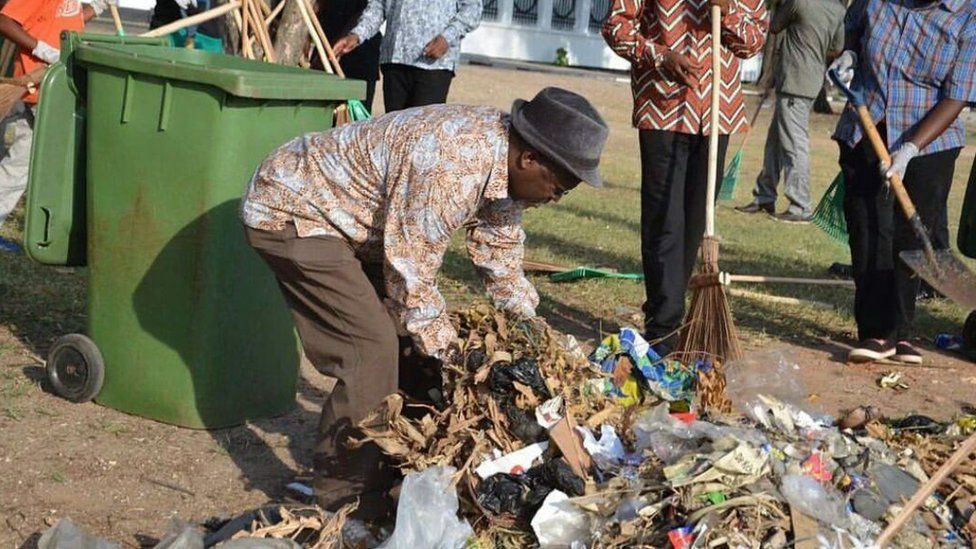
President Magufuli helping clean the streets of Tanzania: In late 2015 and early 2016, #WhatWouldMagufuliDo became a trend on Twitter. Credit: BBC.
A new presidency

Since Magufuli’s death, his vice-president, Samia Suluhu Hassan, has taken office. These are new and exciting times for Tanzania as she is the country’s first female president.

Mwaijande has shared his thoughts regarding this:

“I am very positive about my president Samia Suluhu Hassan. She was working with President Magufuli so they had same goals… She is true leader we have to give her time to show how much respect and love she has for our country… For me, I expecting a lot from my President Samia Suluhu Hassan… I pray for her to have power to do the best for our country.”

Although there is an air of positivity surrounding this new appointment, there are concerns surrounding the return of corruption. One local shared:

“I think Magufuli’s death may impact Tanzania integrity, a thing which may bring back corruption… from only a day after his death we experience big scandals of corruption, which forced Madam President Samia to re-appoint a new cabinet of ministers to assist her reign.”

A citizen observed that an appointment of a female president may have been Magufuli’s plan all along:

“Magufuli knew of his health status and he was always ready to departure, though wishing to leave a legacy… It’s like he knew for Tanzania to have a female president it will be a dream with current generation.”

Having already made a difference in media freedom and foreign policy, it will be exciting to see what further work the new President Hassan has in store for Tanzania.


­­­­I wrote this article in May 2021 for an International Journalism module. We were tasked with writing a 1,500 word topical feature article on a country of our choice.

Cover image credit: Paul Kagame via Flickr

Traditional medicines: Tanzania’s alternative approach to treating COVID

Renowned in the Western world as Tanzania’s “COVID-denying” president, John Magufuli’s response to the global pandemic has been a surprise to many.


Tanzania last updated the World Health Organisation with COVID cases and death statistics on 8th May 2020. Reuters has reported, “President John Magufuli’s sceptical approach towards COVID-19 has caused alarm among WHO officials”.

Tanzania’s response to COVID

Magufuli’s initial response to the pandemic had been one of emergency. However, after a pawpaw fruit and goat tested positive for COVID, the president declared doubts on the accuracy of tests imported from abroad.

Although reports describe Magufuli as COVID-denying, this does not seem to be the case. Safety measures, such as hand sanitisation, mask-wearing and social distancing, are in place in Tanzania.

Official documents, such as the National Park’s COVID-19 Health and Safety Standard Operating Procedures, provide details on Tanzania’s COVID guidelines.

However, the president has not put the country into lockdown and measures are not mandatory, just recommended.

Many Tanzanians have supported Magufuli in his response to COVID. Local mountain guide, Faraja Mwaijande, 45, shared:

“President Magufuli didn’t lockdown the country because most of Tanzania are working to get our daily bread, as we don’t have sustainable income, which was a good move.

“From my point of view, our government did a great job… here in Tanzania, we follow COVID guidelines, but we are not fearing, which makes us feel free and keep working and living normal life.”

John Leonard Minja, 34, has also commented, “COVID exists, and precautions must be taken while fighting to earn our daily bread, for if we don’t keep on with life, death shall be there via hunger and other life-threatening agents.”

Has this been detrimental for Tanzania?

Reuters reported, “The United States said that Tanzania… is experiencing a surge in COVID-19 cases and its healthcare facilities could be quickly overwhelmed”.

When asked to comment on this subject, Mwaijande said that hospitals “[…] are not overwhelmed, just normal. We are not in a bad condition like Western media says.”

He also shared, “Many people get symptoms of Corona and get cured, but very few have died from COVID.”

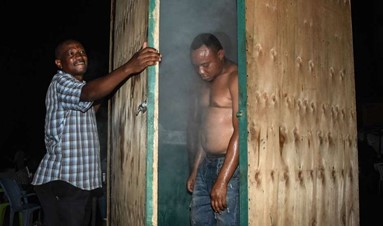
There is no cure to COVID, however, Magufuli has been an advocate of combatting it using traditional treatments; specifically steam inhalation, known as ‘kufukiza’ in Swahili.

When asked if people in Tanzania are still contracting COVID, James Nasary, 26, responded:

“Of course, especially those who live in high population… now people know how to live with the disease, by using local medicine… these remedies combine different trees.”

However, he went on to add, “But in my personal opinion, I do not recommend these because research has not been done by health professionals.”

Traditional medicine has been a part of Tanzanian culture for centuries. Different natural treatments are used depending on the traditions of a tribe.

Mwaijande, a Nyakyusa tribesman, explained:

“People in villages have traditional healers, they know plants and roots that you can use to treat most illnesses.

“If you get cold or other flu illnesses, they will use a steam incubator by boiling eucalyptus leaves and other plants. We have quinine tree that you cut bark off, boil it and drink it, which is treatment for Malaria.”

But not everybody is convinced. In his blog, Shauji Saidi Mpota, states:

“Despite the government reporting that there have been no cases of the coronavirus in Lindi region… myself and a significant majority are of the view that it still exists in our region, but at a small rate compared to the early months.”

As there is no data available on Tanzania’s COVID statistics, it is difficult to determine how successful the country has been in combatting the virus. Nevertheless, Tanzania has a strong, cultural heritage that it is now relying on in these difficult times.

Tanzanian hospitals, Muhimbili National Hospital (MNH) and Mloganzila, have installed steam inhalation machines to help combat COVID. PHOTO via Daily Monitor

­­­­I wrote this article in April 2021 for an International Journalism module. We were tasked with writing a 600 word piece on a country and topic of our choice.